
Quantum Security Engineer: Role, Salary, and Skills in 2026
Search "quantum security engineer" on LinkedIn and you will find job postings at defence primes, investment banks, national laboratories, and hyperscalers, often with a note that fewer than five people applied. The role exists, the demand is real, and the talent pool is thin enough that organisations are increasingly hiring engineers with adjacent backgrounds and building quantum security competence internally.
This article is for the cybersecurity professional considering a pivot into quantum security, and for the hiring manager trying to write a job description that will attract credible candidates. It covers what the role actually involves, what it pays in 2026 in the US and UK (with European context), what skills matter at interview, and where the career leads. For the algorithm selection decisions that a quantum security engineer implements, the FIPS 203/204/205 implementation decision map provides the technical framework.
What the Role Actually Covers
The quantum security engineer role sits at the intersection of three disciplines: applied cryptography (algorithm selection, protocol design, library integration), security architecture (enterprise network and system design), and post-quantum standards literacy (NIST FIPS 203/204/205/206, IETF standards, NCSC and NSA guidance). Combining all three in a single individual is what makes the role difficult to fill.
It is not a research position. Quantum security engineers implement and deploy quantum-safe cryptographic solutions, they do not advance the underlying mathematics. The academics who designed ML-KEM work at universities and national laboratories. The engineers who deploy it work at banks, defence contractors, and large technology organisations.
Day-to-day responsibilities in 2026 typically span several overlapping workstreams. A quantum security engineer conducts cryptographic inventories, mapping every instance of RSA, ECDSA, ECDH, and finite-field Diffie-Hellman across an organisation's systems to build a Cryptographic Bill of Materials (CBOM). They assess Harvest Now, Decrypt Later (HNDL) exposure for long-lived sensitive data. They select and implement ML-KEM (FIPS 203), ML-DSA (FIPS 204), SLH-DSA (FIPS 205), or FN-DSA (FIPS 206) for specific use cases, and integrate post-quantum cryptographic libraries, Open Quantum Safe liboqs, BouncyCastle, OpenSSL 3.x, into existing systems. They advise on hybrid TLS deployment, and they track the evolving standards landscape through IETF working groups and NIST FIPS updates.
Organisationally, the role sits within a cryptography or security architecture team in larger enterprises, typically reporting to a CISO or VP of Security. In smaller organisations or consultancies, it often combines quantum security responsibilities with broader PKI or identity engineering. A pure quantum security engineering position as a standalone role is predominantly found in large enterprises, defence contractors, financial services institutions, and government agencies.
What the Role Pays in 2026
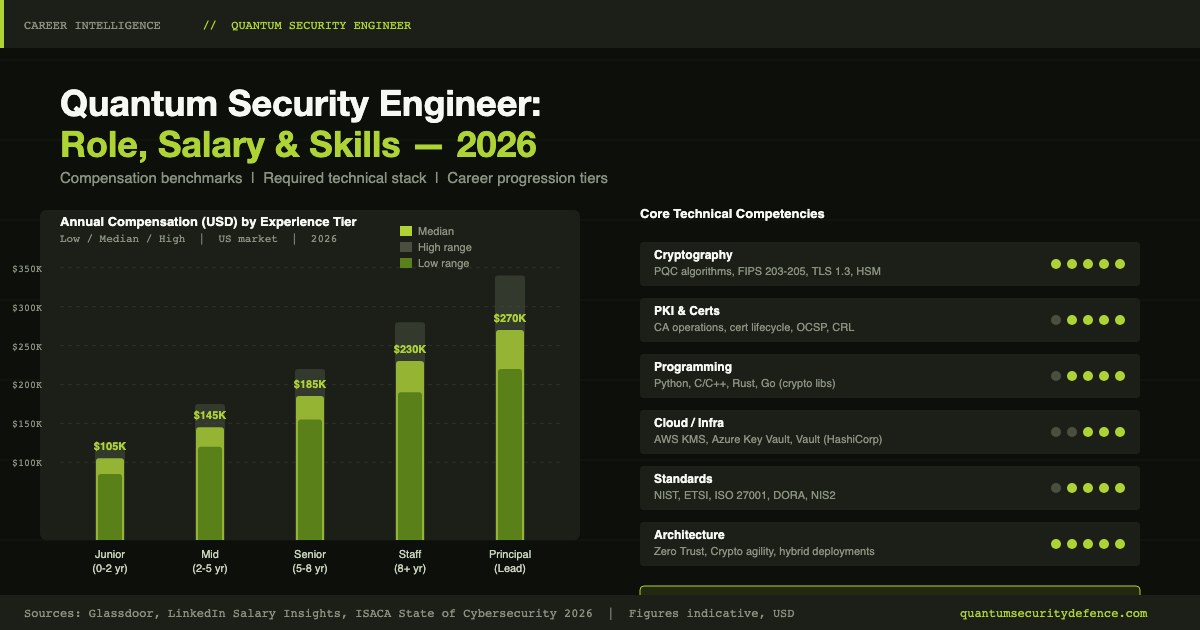
Published salary benchmarks specifically for "quantum security engineer" as a distinct job category are limited. The figures below are derived from compensation surveys for adjacent roles (cryptographic engineer, security architect, PKI engineer), publicly visible job postings at organisations including NSA, GCHQ-aligned contractors, and US defence primes, and ISACA and (ISC)2 compensation data for cybersecurity specialisms. Treat them as indicative ranges, not authoritative benchmarks. Salary data moves faster than this article.
United States. A mid-career quantum security engineer with three to six years of relevant experience and PQC-focused work is likely to command $160,000 to $220,000 in total compensation in major technology centres, the San Francisco Bay Area, Seattle, and New York. Other markets compress to approximately $120,000 to $160,000. Defence and intelligence roles frequently carry clearance premiums of $15,000 to $30,000 on top of base, and Top Secret/SCI clearance eligibility is often required for federal and defence positions.
United Kingdom. London-based roles at the mid-senior level typically range from £90,000 to £130,000 base salary, with total compensation including bonus in the £100,000 to £150,000 range. GCHQ, NCSC, and defence contractor roles at BAE Systems, QinetiQ, and Leonardo UK are the primary hiring pools outside financial services. Regional roles outside London tend to run £65,000 to £90,000.
Europe. The quantum security specialism is less established as a distinct job title in most European markets. Germany, the Netherlands, and France have active hiring, primarily in government-adjacent defence and critical infrastructure organisations. Salary ranges broadly track senior cybersecurity architect compensation in the local market, adjusted upward for the specialism. French grandes entreprises and German defence-adjacent organisations are the most active hirers in this category.
The specialist premium over a comparable senior security architect is approximately 15 to 25 percent. That premium reflects genuine skill scarcity. The talent pool with deep PQC implementation experience remains concentrated at a small number of universities and national laboratories. It will not commoditise quickly, the migration programme is a decade long, and the skills required to run it (deep cryptographic knowledge, enterprise PKI experience, standards literacy) are not the kind that can be learned in an afternoon.
Core Technical Skills: The Non-Negotiables
Applied cryptography fundamentals are the foundation. A quantum security engineer must understand classical public-key cryptography well enough to explain its vulnerabilities under the quantum threat model, not just operate it. That means understanding Shor's algorithm at the conceptual level, why discrete logarithm and integer factorisation problems collapse under a quantum computation, and Grover's algorithm and its implication for symmetric key sizing. Doctoral-level quantum physics is not required. The professional engineer needs the applied layer: why RSA-2048 fails and AES-256 does not.
NIST PQC standards proficiency is non-negotiable. ML-KEM (FIPS 203), ML-DSA (FIPS 204), SLH-DSA (FIPS 205), and FN-DSA (FIPS 206) are the standardised algorithm suite. A competent engineer knows the parameter sets, performance profiles, and use-case fit of each. Knowing when to use ML-KEM-768 versus ML-KEM-1024, and why that choice involves a security level versus performance trade-off, is a common interview differentiator. Understanding why submission names (Kyber, Dilithium, SPHINCS+, FALCON) differ from the standardised FIPS names is basic professional communication hygiene at this point.
Cryptographic library integration is the practical floor for engineering roles. Hands-on experience with at least one of: Open Quantum Safe liboqs (C/Python/Go bindings), BouncyCastle (Java, C#), or OpenSSL 3.x with OQS provider support. The ability to write a working ML-KEM key exchange or ML-DSA signing operation in a real language separates engineering candidates from advisory ones. For algorithm selection detail, see the FIPS implementation decision map.
PKI and certificate management are the engineering surface on which quantum security work lands. X.509 certificate chains (RFC 5280), certificate lifecycle management, ACME protocol (RFC 8555), and HSM integration via PKCS#11 are all expected knowledge. These are not quantum-specific, but an engineer without them cannot complete a real migration.
TLS and network protocol stack knowledge rounds out the core. Configuring hybrid TLS 1.3 key exchange (X25519 plus ML-KEM-768) using current tooling, nginx, HAProxy, Cloudflare Workers, and interpreting Wireshark captures showing hybrid handshakes are practical skills that come up in both the engineering role and the technical interview. Understanding IETF draft-ietf-tls-hybrid-design and RFC 9496 (X-Wing Hybrid KEM) situates that practical work in its standards context.
Standards and Compliance Literacy
A quantum security engineer in a regulated sector must translate regulatory obligations into technical controls. That requires understanding the relevant frameworks in enough depth to have a conversation with a compliance team, not just tick a box. In 2026, the relevant landscape includes NIST IR 8547 (November 2024) for algorithm transition timelines, NCSC PQC migration guidance (March 2025) for UK organisations, NSA CNSA 2.0 for organisations with US defence or national security exposure, and NIS2 Article 21 for EU-regulated critical infrastructure operators.
For roles in EU financial services, DORA (EU Digital Operational Resilience Act, Regulation 2022/2554), specifically Article 4 and Annex I on ICT risk management and cryptographic controls, is relevant. DORA applies to EU financial entities and their ICT service providers. It does not bind UK-only organisations. UK financial services roles require familiarity with FCA operational resilience rules and PRA position papers on cryptographic controls instead. The detailed DORA analysis, including its practical implications for PQC migration, is covered at DORA and post-quantum cryptography.
Certifications and Learning Pathways
There is no dedicated quantum security engineer certification as of 2026. The role is emerging faster than the credentialling landscape. Hiring managers accept several established credentials as proxies: CISSP demonstrates broad security architecture knowledge and professional standing; CISM signals organisational security programme maturity; OSCP or CEH demonstrates applied technical competence for engineers who want to show practical security skills alongside quantum-specific knowledge. For a full assessment of which cybersecurity certifications carry weight in the quantum era and how they compare, see cybersecurity certifications for the quantum era. For professionals deciding between ISC2 and ISACA credentials specifically, the ISC2 vs ISACA comparison for quantum security professionals covers the practical differences.
IBM and Google Cloud both offer quantum computing certificates (IBM Quantum Learning, Google Quantum AI courses) that demonstrate quantum computing awareness. These are not quantum security engineering credentials, they cover quantum algorithms and hardware at a conceptual level. They are useful background, not a substitute for the cryptographic engineering skills the role requires.
University programmes with relevant content at postgraduate level include UCL's MSc Information Security (post-quantum cryptography modules), the University of Waterloo's Institute for Quantum Computing (research-focused), the University of Technology Sydney's quantum cybersecurity programme, and ETH Zurich's quantum information and cryptography courses. Programme offerings change annually; verify specific module availability before applying. For the undergraduate background, a BSc or MSc in Mathematics or Computer Science with elective cryptography content transfers more directly to the engineering role than a theoretical physics degree, the physics is interesting background, but the practical engineering work is algebraic and computational.
How to Get In, and Where It Leads
Most engineers entering quantum security arrive from applied cryptography, PKI engineering, or security architecture. A cryptography module at university level followed by three to five years in PKI engineering or TLS stack work is the most common background. The skills transfer directly: certificate lifecycle management, HSM operation, PKCS#11 integration, and TLS configuration are all required in quantum security roles and already mastered in PKI engineering.
Switching from general cybersecurity, penetration testing, SOC analysis, vulnerability management, requires additional applied cryptography study. The conceptual distance is real. A security analyst who understands cryptography at the "it encrypts data" level needs to develop working knowledge of algorithm mechanics, key management, and protocol design before the pivot makes sense.
Senior quantum security engineers move into cryptography leadership (Head of Cryptography, Chief Cryptography Officer), quantum security programme management leading multi-year PQC migration programmes, or advisory and consulting work with regulators, defence contractors, and financial institutions on migration readiness. The consultancy path is particularly active. There is a structural surplus of organisations that need help and a structural shortage of engineers qualified to provide it, and that gap will persist well into the 2030s as the migration programme runs its course.
Sources
- NIST FIPS 203 (ML-KEM), August 2024, doi.org/10.6028/NIST.FIPS.203
- NIST FIPS 204 (ML-DSA), August 2024, doi.org/10.6028/NIST.FIPS.204
- NIST FIPS 205 (SLH-DSA), August 2024, doi.org/10.6028/NIST.FIPS.205
- NIST FIPS 206 (FN-DSA), October 2024, doi.org/10.6028/NIST.FIPS.206
- NIST IR 8547, November 2024, doi.org/10.6028/NIST.IR.8547
- NIST NCCoE SP 1800-38B, Migration to Post-Quantum Cryptography, 2024, nccoe.nist.gov
- Open Quantum Safe liboqs, v0.10.x, openquantumsafe.org
- OpenSSL 3.x OQS provider, github.com/open-quantum-safe/oqs-provider
- IETF draft-ietf-tls-hybrid-design, datatracker.ietf.org
- IETF RFC 9496, X-Wing Hybrid KEM, 2024, rfc-editor.org/rfc/rfc9496
- Shor, "Algorithms for quantum computation," FOCS 1994, doi.org/10.1109/SFCS.1994.365700
- Grover, "A fast quantum mechanical algorithm for database search," STOC 1996, doi.org/10.1145/237814.237866
- NSA CNSA 2.0 Advisory, September 2022, media.defense.gov
- NCSC, "Next steps in preparing for post-quantum cryptography," March 2025, ncsc.gov.uk
- DORA, Regulation (EU) 2022/2554, eur-lex.europa.eu
- (ISC)2 Cybersecurity Workforce Study, 2024, isc2.org
- ISACA State of Cybersecurity Survey, 2025, isaca.org
- RFC 5280, X.509 Certificate Profile, rfc-editor.org/rfc/rfc5280
- RFC 8555, ACME Protocol, rfc-editor.org/rfc/rfc8555
- IBM Quantum Learning, learning.quantum.ibm.com