
Quantum Networking Explained: How Quantum Repeaters and Entanglement Distribution Work
25 June 2026
<h2>Why quantum networks cannot work like classical networks</h2>
<p>Classical optical repeaters work by measuring the incoming signal and re-amplifying it. Measure, copy, transmit. This is precisely what quantum networks cannot do. The no-cloning theorem, proved by Wootters and Zurek in 1982, establishes that an unknown quantum state cannot be copied. The moment you measure a quantum system to amplify it, you destroy the state you were trying to forward. That single physical constraint is the reason the entire engineering challenge described in this article exists.</p>
<p>Classical optical fibre encodes information as amplitude, phase, or polarisation of light pulses. Quantum networks work differently: they distribute entangled quantum states between nodes. The resource being transmitted is not a signal but a correlation. Two photons produced in an entangled pair carry correlated quantum states such that measuring one particle instantaneously determines the outcome for the other, regardless of the distance separating them. This cannot be used to send information faster than light (the no-communication theorem prohibits it), but it is the physical resource on which quantum key distribution, distributed quantum computing, and quantum sensing all depend.</p>
<p>The primary near-term commercial driver for quantum networking is quantum key distribution (QKD). Entanglement-based QKD protocols such as BBM92 (Bennett, Brassard, and Mermin, 1992) require two parties to share entangled photon pairs to establish cryptographic key material with information-theoretic security. Getting those entangled pairs from A to B over long distances is the infrastructure problem. Beyond QKD, the same infrastructure enables distributed quantum computing, where quantum processors at separate nodes share entanglement to jointly execute computations; quantum-enhanced sensing across separated detectors; and blind quantum computing, where a client delegates computation to a remote server without the server learning the input. The Wehner, Elkouss, and Hanson roadmap in <em>Science</em> (2018) provides the taxonomy of quantum internet applications and the capability tiers required for each. If you have encountered both QKD and post-quantum cryptography (PQC) and are uncertain how they relate, the distinction is covered in <a href="/quantum-news/post-quantum-vs-quantum-cryptography-difference/">post-quantum vs quantum cryptography</a> on this site.</p>
<h2>The distance problem: why photon loss makes direct distribution unworkable</h2>
<p>Standard single-mode optical fibre at 1550 nm (telecom C-band) has an attenuation of approximately 0.2 dB/km. That figure sounds modest until you apply it to 300 km: the channel transmission drops to approximately 10<sup>-6</sup>. One in a million photons arrives. At a typical entangled photon pair source rate of 10<sup>7</sup> pairs per second, you expect roughly 10 pairs per second to arrive at 300 km before accounting for detection losses, coincidence windowing, and dark counts in the single-photon detectors at the far end. Pirandola et al. (2020) provides the detailed figures across the loss regime. The usable key rate at that distance, even under optimistic assumptions, is negligible for any practical cryptographic application.</p>
<p>Free-space transmission bypasses fibre attenuation but trades one set of constraints for another. Atmospheric turbulence, cloud cover, and beam divergence all reduce link reliability. The Chinese Micius satellite (launched 2016) demonstrated that satellite-to-ground QKD at distances exceeding 1,200 km is physically achievable: Liao et al. (2017) reported keys distributed between the Xinglong and Nanshan ground stations using a decoy-state BB84 protocol at a rate that was modest but non-zero. Micius is a significant distance milestone. It is not, however, a demonstration of quantum repeater technology. No quantum memory was used, no entanglement swapping occurred. The satellite bridges the distance by operating above the atmosphere, not by overcoming the fundamental loss problem for terrestrial fibre.</p>
<p>The quantitative limit for repeaterless systems over lossy channels is the Pirandola-Laurenza-Ottaviani-Banchi (PLOB) bound (Pirandola et al., 2017). This gives the maximum entanglement distribution rate achievable without quantum repeaters as a function of channel transmittance. For practical fibre at 300 km or beyond, the PLOB bound places the repeaterless key rate well below what a real application requires. Overcoming that limit is precisely what quantum repeaters are designed to do.</p>
<h2>How a quantum repeater works: entanglement swapping at nodes</h2>
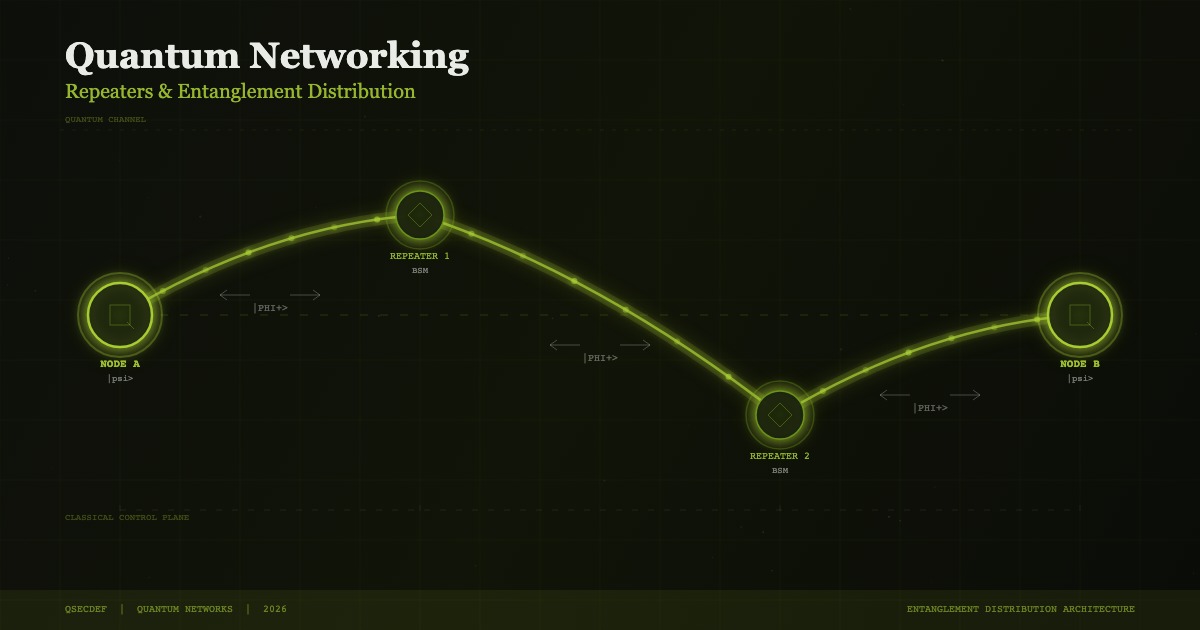
<p>The quantum repeater concept was introduced by Briegel, Dür, Cirac, and Zoller in 1998. The key insight is decomposition: rather than transmitting entanglement end-to-end over a long lossy channel, divide the channel into shorter segments. Establish entanglement independently on each segment, then extend it to cover the full distance through a process called entanglement swapping. No quantum state travels the full channel. The repeater does not amplify anything.</p>
<p>Walk through the two-segment case. Three nodes: Alice (A), a repeater node (R), and Bob (B). A source at or near R produces two entangled photon pairs. One photon from pair 1 goes to A; one photon from pair 2 goes to B. Node R now holds one qubit from the A-R pair and one qubit from the R-B pair. R performs a Bell-state measurement on its two qubits. This measurement projects A's photon and B's photon into an entangled state, even though they have never directly interacted. The measurement outcome is communicated to A or B over a classical channel, and that classical message is what completes the entanglement. Without it, A and B have no correlations whatsoever. This is the mechanism introduced by Zukowski, Zeilinger, Horne, and Ekert in their 1993 paper on event-ready Bell experiments via entanglement swapping.</p>
<p>In linear-optical implementations, the Bell-state measurement is probabilistic. Using only linear optics and photodetectors, you can distinguish at most two of the four Bell states. This limits the swapping success probability to 50%. In a multi-hop chain with many segments, these probabilities compound multiplicatively. A chain of ten segments at 50% success per hop gives an end-to-end success probability of less than 0.1%. Quantum memory is the component that prevents this from being catastrophic: when a successful entanglement event occurs on segment 1 but not yet on segment 2, the memory holds the entangled state on segment 1 while segment 2 retries, rather than discarding the successful result. Without memory, every segment failure forces a restart of the entire chain. Lutkenhaus, Calsamiglia, and Suominen (1999) established the linear-optics Bell-state measurement limits that define this architecture. A quantum repeater node requires three co-located capabilities: a quantum memory, a Bell-state measurement apparatus, and local quantum operations for swapping and, in more advanced implementations, purification.</p>
<h2>Entanglement purification: recovering fidelity from noisy channels</h2>
<p>A photon that has traversed a real fibre link does not arrive in a maximally entangled state. Depolarising noise, dephasing, and scattering degrade the fidelity of the entangled pair. A noisy entangled pair is described as a mixed quantum state rather than the pure maximally entangled state you want. Entanglement purification, introduced by Bennett, Brassard, Popescu, Schumacher, Smolin, and Wootters in 1996, addresses this by trading quantity for quality. Take multiple noisy entangled pairs and, using only local operations and classical communication (LOCC), distil a smaller number of higher-fidelity pairs. The resource cost is real: purification consumes input pairs to produce output pairs with higher fidelity, and multiple rounds of purification are required as the link distance increases.</p>
<p>The Briegel-Dür-Cirac-Zoller (BDCZ) protocol nests purification and swapping in a specific alternating sequence. Establish entanglement on short segments, purify each segment to a target fidelity, swap to extend the range, then purify again at the new length. Repeat as required. Dür, Briegel, Cirac, and Zoller (1999) showed that this nested procedure allows end-to-end fidelity to approach unity at the cost of additional classical communication rounds and resource consumption. The decisive result is the scaling: the BDCZ protocol achieves polynomial growth in resource requirements as a function of distance, rather than the exponential scaling of direct transmission. For a reader building intuition, the practical implication is this: longer chains require more purification rounds, which require more input entangled pairs, which require more time to generate. That overhead is the price of extending quantum networks beyond the direct-transmission limit.</p>
<h2>Quantum memory: the component that makes repeaters possible</h2>
<p>Quantum memory stores an entangled quantum state for a controlled period, allowing asynchronous coordination between adjacent repeater segments. Without it, a successful entanglement event on one segment cannot wait for the adjacent segment to succeed. The performance of a quantum repeater network is bounded by the performance of its weakest quantum memory.</p>
<p>Four parameters define a quantum memory for repeater applications: storage lifetime (coherence time), efficiency (fraction of incoming photons stored successfully), multimode capacity (how many temporal or spectral modes can be stored simultaneously, which determines the multiplexed link rate), and wavelength compatibility with telecom C-band fibre at 1550 nm. No current platform simultaneously achieves all four at useful scale. The table below summarises the leading platforms:</p>
<table>
<thead>
<tr>
<th>Platform</th>
<th>Best reported coherence time</th>
<th>Storage efficiency</th>
<th>Multimode capacity</th>
<th>Native telecom wavelength</th>
</tr>
</thead>
<tbody>
<tr>
<td>Atomic ensembles (Rb vapour, DLCZ)</td>
<td>Milliseconds (at room temp)</td>
<td>Up to ~70%</td>
<td>>1,000 temporal modes (Vernaz-Gris et al., 2018)</td>
<td>No (780 nm)</td>
</tr>
<tr>
<td>Rare-earth doped crystals (Eu:Y<sub>2</sub>SiO<sub>5</sub>)</td>
<td>6 hours (nuclear spin; Zhong et al., 2015)</td>
<td>Moderate (AFC protocol)</td>
<td>Moderate</td>
<td>No (580 nm; wavelength conversion needed)</td>
</tr>
<tr>
<td>NV centres in diamond</td>
<td>Microseconds (optical, room temp); milliseconds (cryogenic)</td>
<td>Low (<10% optical)</td>
<td>Low</td>
<td>No (637 nm)</td>
</tr>
<tr>
<td>Trapped ions</td>
<td>Seconds to minutes (hyperfine)</td>
<td>High (near-deterministic)</td>
<td>Limited by trap size</td>
<td>No (visible/near-IR)</td>
</tr>
</tbody>
</table>
<p>The DLCZ protocol, proposed by Duan, Lukin, Cirac, and Zoller in 2001, established atomic ensembles as the basis for long-distance quantum communication using linear optics. The six-hour coherence time in Zhong et al. (2015) is a nuclear spin result, not an optical memory result; the distinction matters because optical transitions are what couple the memory to the photonic network. The multimode result from Vernaz-Gris et al. (2018), exceeding 1,000 temporal modes in a cold rubidium ensemble, is significant because multiplexing is the practical route to acceptable entanglement distribution rates.</p>
<p>The wavelength conversion problem compounds the platform trade-offs. Systems achieving the best coherence times operate at wavelengths from 400 to 900 nm, far from the 1550 nm telecom window where fibre attenuation is minimal. Converting from these wavelengths to 1550 nm while preserving quantum coherence uses nonlinear optical processes (sum-frequency and difference-frequency generation). Krutyanskiy et al. (2019) demonstrated light-matter entanglement over 50 km of optical fibre using wavelength conversion from a calcium ion at 854 nm to 1550 nm, with conversion efficiencies sufficient to detect the entanglement. Noise floors in the conversion process remain an engineering constraint for field deployment.</p>
<h2>Three generations of quantum repeater architectures</h2>
<p>The literature uses varied terminology for repeater architectures, but the most widely cited organising framework is the three-generation taxonomy described by Muralidharan et al. (2016) in their analysis of optimal architectures for long-distance quantum communication. It is worth attributing explicitly rather than presenting it as a universal consensus, because different groups use different classifications.</p>
<ul>
<li><strong>First generation (error detection via entanglement purification):</strong> Entanglement is established on segments, purified using LOCC, and extended via swapping as described above. Requires quantum memory. The round-trip classical communication needed for purification introduces latency, but gate error rates of around 1% are tolerable. This is the architecture closest to near-term implementation. The Delft network (discussed below) is a first-generation experiment.</li>
<li><strong>Second generation (partial quantum error correction):</strong> Logical qubits are encoded across multiple physical qubits on each segment, reducing the number of purification rounds required. Lower latency than first-generation but demands gate error rates near 0.1% — a factor of ten better than current state-of-the-art in most platforms.</li>
<li><strong>Third generation (full one-way quantum error correction):</strong> Fault-tolerant quantum gates at each node allow one-way quantum communication without classical feedback between nodes. Lowest latency, highest performance, highest hardware requirements. Currently well beyond the experimental state of the art for field-deployable nodes.</li>
</ul>
<p>Current experiments sit in first-generation territory. Second-generation components are under development in academic labs, primarily in the context of fault-tolerant quantum computing research. Third-generation quantum repeaters require hardware capabilities that do not yet exist in laboratory demonstrations at the required error rates, let alone in deployable form.</p>
<h2>The experimental state of the art and what the roadmaps say</h2>
<p>The landmark experiment in quantum repeater technology is the Delft three-node network reported by Pompili et al. in <em>Science</em> in 2021. Three nodes using nitrogen-vacancy centres in diamond as quantum nodes were connected over 35 km of fibre: Alice and Bob as end points, with Charlie as a repeater node. Entanglement swapping at Charlie connected Alice and Bob. The key metrics: entanglement generation rate of approximately 1 Hz over the full link, fidelity of approximately 0.70, and coherence time sufficient for the protocol. Those numbers look modest until you consider what they represent. A metropolitan QKD deployment needs rates in the kilohertz-to-megahertz range; the Delft result is at 1 Hz. The engineering gap between the 2021 result and a deployable quantum repeater network is still measured in orders of magnitude for the core performance parameters. That is a description of the current state of the art, not a criticism of the research.</p>
<p>The European Quantum Internet Alliance (QIA) roadmap (2022) defines four network tiers as milestones: Trusted Repeater, Prepare-and-Measure, Entanglement Distribution, and Quantum Memory networks. Trusted Repeater networks are commercially available today from vendors such as Toshiba Quantum and ID Quantique. They are not quantum repeater networks. In a trusted node (or trusted repeater) network, each relay decrypts key material and re-encrypts it. The relay has access to the key material at all times. Security depends on trusting every node in the chain. In a quantum repeater network using entanglement swapping, the intermediate nodes perform a Bell-state measurement but never have access to the end-to-end key material. The security model is categorically different. The QIA roadmap targets a Prepare-and-Measure tier by approximately 2025-2028 and an Entanglement Distribution tier by approximately 2028-2032, with the Quantum Memory tier (genuine quantum repeaters at metropolitan scale) targeted for 2032-2035. These are planning targets, not guaranteed delivery dates, and the roadmap is subject to revision as the technology develops.</p>
<p>The US Department of Energy Strategic Vision for Quantum Networks (2020) identifies the same three technical pillars: quantum memory, entanglement swapping, and purification, and targets a prototype quantum internet within ten years of publication. The DOE blueprint names three near-term test beds at Argonne/Fermilab, Brookhaven/ESnet, and Caltech/Fermilab using existing fibre infrastructure as the experimental platforms for this work.</p>
<p>The practical state of quantum networking in 2026 is this: trusted node networks exist and can be purchased. Quantum repeater networks with genuine quantum memory and entanglement swapping at field scale do not yet exist. The Delft 2021 result established that the physics works in laboratory conditions; the engineering required to move from that result to a deployable metropolitan network is the work of the 2030s, not the 2020s. The distance and rate performance that would make quantum repeater networks operationally useful for most applications requires progress on quantum memory that is currently in laboratory demonstration phase. Understanding where that boundary sits is essential for any organisation planning a quantum-safe communications strategy and evaluating claims from vendors in this space.</p>
Sources
- Wootters, W.K. and Zurek, W.H., "A single quantum cannot be cloned," Nature 299, 802-803 (1982). doi:10.1038/299802a0
- Bennett, C.H., Brassard, G., Mermin, N.D., "Quantum cryptography without Bell's theorem," Physical Review Letters 68(5), 557 (1992). doi:10.1103/PhysRevLett.68.557
- Wehner, S., Elkouss, D., Hanson, R., "Quantum internet: A vision for the road ahead," Science 362(6412), eaam9288 (2018). doi:10.1126/science.aam9288
- Pirandola, S. et al., "Advances in quantum cryptography," Advances in Optics and Photonics 12(4), 1012-1236 (2020). doi:10.1364/AOP.361502
- Liao, S.-K. et al., "Satellite-to-ground quantum key distribution," Nature 549, 43-47 (2017). doi:10.1038/nature23655
- Pirandola, S., Laurenza, R., Ottaviani, C., Banchi, L., "Fundamental limits of repeaterless quantum communications," Nature Communications 8, 15043 (2017). doi:10.1038/ncomms15043
- Briegel, H.-J., Dur, W., Cirac, J.I., Zoller, P., "Quantum repeaters: the role of imperfect local operations in quantum communication," Physical Review Letters 81(26), 5932 (1998). doi:10.1103/PhysRevLett.81.5932
- Sangouard, N., Simon, C., de Riedmatten, H., Gisin, N., "Quantum repeaters based on atomic ensembles and linear optics," Reviews of Modern Physics 83(1), 33 (2011). doi:10.1103/RevModPhys.83.33
- Zukowski, M., Zeilinger, A., Horne, M.A., Ekert, A.K., "Event-ready-detectors Bell experiment via entanglement swapping," Physical Review Letters 71(26), 4287 (1993). doi:10.1103/PhysRevLett.71.4287
- Lutkenhaus, N., Calsamiglia, J., Suominen, K.-A., "Bell measurements for teleportation," Physical Review A 59(5), 3295 (1999). doi:10.1103/PhysRevA.59.3295
- Bennett, C.H. et al., "Purification of noisy entanglement and faithful teleportation via noisy channels," Physical Review Letters 76(5), 722 (1996). doi:10.1103/PhysRevLett.76.722
- Dur, W., Briegel, H.-J., Cirac, J.I., Zoller, P., "Quantum repeaters based on entanglement purification," Physical Review A 59(1), 169 (1999). doi:10.1103/PhysRevA.59.169
- Duan, L.-M., Lukin, M.D., Cirac, J.I., Zoller, P., "Long-distance quantum communication with atomic ensembles and linear optics," Nature 414, 413-418 (2001). doi:10.1038/35106500
- Zhong, M. et al., "Optically addressable nuclear spins in a solid with a six-hour coherence time," Nature 517, 177-180 (2015). doi:10.1038/nature14025
- Vernaz-Gris, P. et al., "Highly-efficient quantum memory for polarization qubits in a spatially-multiplexed cold atomic ensemble," Nature Communications 9, 363 (2018). doi:10.1038/s41467-017-02775-8
- Krutyanskiy, V. et al., "Light-matter entanglement over 50 km of optical fibre," npj Quantum Information 5, 72 (2019). doi:10.1038/s41534-019-0186-3
- Muralidharan, S. et al., "Optimal architectures for long distance quantum communication," Scientific Reports 6, 20463 (2016). doi:10.1038/srep20463
- Pompili, M. et al., "Realization of a multinode quantum network of remote solid-state qubits," Science 372(6539), 259-264 (2021). doi:10.1126/science.abg1919
- QIA, "A Quantum Internet Alliance Roadmap," 2022. quantum-internet.team/roadmap
- US DOE, "A Strategic Vision for America's Quantum Networks," February 2020. DOE Strategic Vision