Get access to our live events, papers and training
Join the Tuesday 3pm CET peer reviews
Request our membership pack
Join the Tuesday 3pm CET peer reviews
PROFESSIONAL NETWORK
Join the World's Largest Community of Quantum Security Professionals
QSECDEF brings together the practitioners, policymakers, and vendors actively shaping the post-quantum transition. Members share early intelligence on tooling, procurement developments, and regulatory shifts before that information reaches the public domain. This is the professional network the field converges on.
More than 1,200 members from 40+ countries, including Five Eyes governments, NATO member institutions, and the leading quantum vendors are already part of the community.
EVENT INVITATIONS
Get Early Invitations to Quantum Security Events and Webinars
QSECDEF hosts closed briefings, practitioner webinars, and in-person events attended by defence agencies, central banks, and critical infrastructure teams. Members receive invitations before public registration opens. Several events are members-only and never open to the public.
600+ organisations across 40+ countries are represented in our member community, including defence ministries, NATO institutions, and Five Eyes government agencies.
THREAT INTELLIGENCE
The Briefing That Closes Your Quantum Threat Picture
Most organisations have a PQC roadmap. Fewer have a reliable signal on where the actual threat timeline sits, which vendors' claims hold up under scrutiny, and what peer organisations at your maturity level are doing. QSECDEF membership exists to close that gap. One briefing cycle has changed procurement decisions at organisations you would recognise.
Members include CISOs, heads of cryptography, and national security advisors from 40+ countries. The Five Eyes and NATO institutions read what we publish.
1,200+MEMBERS
40+COUNTRIES
600+ORGANISATIONS
Check your email and junk email for information and add us to your safe senders list.
End-to-End Encryption: What It Protects Against Today and What Quantum Computers Will Break
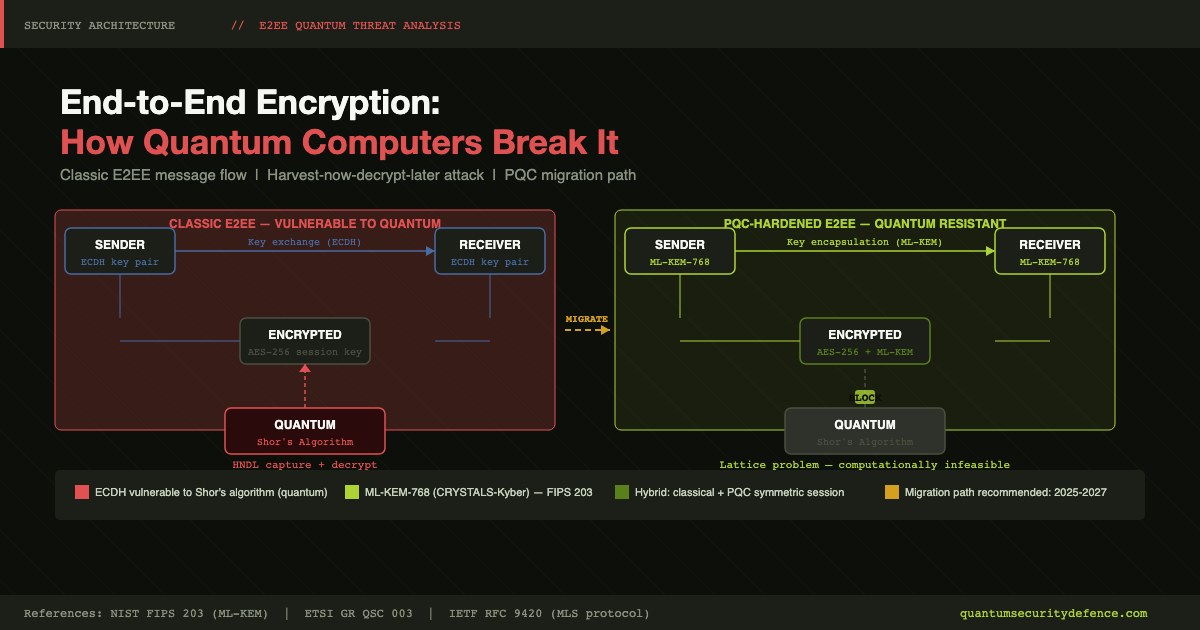
A quantum computer breaks the key exchange step of end-to-end encryption, not the bulk message cipher. The risk profile varies by application design. Signal and Apple iMessage have already shipped post-quantum key exchange. PGP email has not.
End-to-End Encryption: What It Protects Against Today and What Quantum Computers Will Break
Most coverage of quantum computers and encryption either catastrophises or dismisses. Quantum will break everything. Or: relax, it's decades away. Neither answer is useful, and neither is accurate.
The precise answer is this: a quantum computer would break the key exchange step of end-to-end encryption (E2EE), not the bulk message cipher. That distinction matters a great deal, because some E2EE systems are already protected against it, some are not, and the risk profile varies considerably depending on how the application was designed. This article works through the mechanics carefully so you can assess your own situation rather than rely on a headline.
What End-to-End Encryption Actually Does
End-to-end encryption is a scheme in which a message is encrypted on the sender's device and decrypted only on the recipient's device. The service provider in the middle, the messaging platform, the email server, the cloud storage operator, never holds the decryption key. It sees ciphertext. Even a subpoena to the service provider yields nothing readable.
This works because E2EE has two distinct cryptographic components, and it's important to keep them separate in your thinking.
The first is the key exchange. Before any messages are encrypted, the two parties need to agree on a shared secret, a key that will lock and unlock the messages. They cannot send this key over the network (an interceptor would capture it), so instead they use a mathematical protocol called Elliptic Curve Diffie-Hellman (ECDH) to derive a shared secret without either party transmitting it. Signal and WhatsApp both use Curve25519, a specific ECDH implementation. The key exchange establishes what the session key will be.
The second is the message cipher. Once the shared secret exists, messages are encrypted with AES-256 (or in some cases ChaCha20-Poly1305), fast, battle-tested symmetric encryption. The session key locks and unlocks message content. This is the bulk encryption that actually handles your text, files, and calls.
Signal's protocol adds a third layer on top of this: forward secrecy, implemented via its X3DH initial key agreement and Double Ratchet ongoing ratcheting. With forward secrecy, each session generates throwaway keys that are discarded after use. If an attacker compromises your long-term keys tomorrow, they cannot use them to decrypt messages from today's session, those session keys are already gone. WhatsApp uses the Signal Protocol and inherits the same properties.
What E2EE does not protect against: an adversary who controls your unlocked device (they read the plaintext directly, no cryptography required); metadata, who you message, when, and how often, which is typically visible to the service provider; and key verification failures, where a man-in-the-middle substitutes their own keys and you do not notice because you never checked the safety numbers.
These are classical limitations. They existed before anyone worried about quantum computers.
What a Quantum Computer Actually Breaks
A cryptographically relevant quantum computer (CRQC), one with enough scale and error correction to run attacks against current cryptographic systems, does not exist yet. The central estimate for when one might emerge is 2033 to 2035, though probability distributions vary and the field is moving faster than expected in some areas. The threat is not imminent in the sense of weeks or months. It is plausible within a planning horizon that matters for data with long sensitivity windows.
Two quantum algorithms are relevant here, and they threaten very different things.
Shor's algorithm (1994) can efficiently solve the discrete logarithm problem and the integer factorisation problem. These are the mathematical foundations of ECDH and RSA. An attacker running Shor's on a CRQC could compute the private key from the public key, reconstruct the shared secret, and decrypt any session key derived using ECDH or RSA. This breaks the key exchange component of E2EE. NIST IR 8547 (November 2024) formally designates ECDH for deprecation in new deployments from 2030 on precisely this basis. For a detailed explanation of how Shor's algorithm attacks RSA and ECC specifically, see Shor's algorithm: how it breaks RSA and ECC.
Grover's algorithm (1996) searches an unsorted database of N items in roughly √N operations rather than N. Applied to symmetric cryptography, it halves effective key security. AES-128 would have roughly 64 bits of effective security against a quantum computer, too weak. AES-256 would have roughly 128 bits, still considered computationally infeasible to attack with any technology currently known, classical or quantum.
The practical bottom line: a CRQC breaks the ECDH key exchange. It does not break AES-256 message encryption in any meaningful sense. Signal, WhatsApp, and iMessage use AES-256 (or ChaCha20) for message content. That part is not the problem.
The problem is the shared secret that was established using ECDH. If an attacker can reconstruct that secret, using a future CRQC running Shor's algorithm, they could potentially decrypt sessions where they captured the key exchange traffic.
The Harvest Now, Decrypt Later Risk
This is where the timeline gets uncomfortable. A CRQC does not need to exist today for the threat to be present today. An adversary can capture encrypted traffic now and decrypt it later, once the hardware arrives. This is Harvest Now, Decrypt Later (HNDL), and it is the mechanism that converts a theoretical future threat into a present operational risk for anyone with data worth protecting over a multi-year horizon.
For E2EE applications with forward secrecy, like Signal and WhatsApp, the HNDL risk is significantly reduced. Each session uses ephemeral ECDH keys that are discarded after the session ends. An adversary who captures ciphertext but not the ephemeral key exchange at the time of the session cannot retroactively reconstruct the session key, there is nothing to reconstruct from. Forward secrecy was designed for this kind of retrospective attack.
PGP email works differently and is materially more vulnerable. Standard OpenPGP (RFC 4880) uses a long-term RSA or ECDH key pair, the same private key decrypts every message ever sent to that address. An adversary who harvests PGP-encrypted email archives from 2024 and later obtains the RSA private key (whether through a CRQC or through conventional compromise) can decrypt the entire archive. For journalists communicating with sources under long-term RSA PGP keys, lawyers holding encrypted client correspondence, or diplomats using legacy encrypted email systems, this is not a theoretical concern.
The asymmetry is worth stating plainly. For personal use of Signal or WhatsApp, the quantum risk is low: forward secrecy substantially mitigates retroactive decryption. For encrypted email with long-term RSA key pairs and long-lived sensitive archives, the HNDL risk is genuine and the exposure begins accumulating now, before any CRQC exists.
Which Applications Are Already Responding
The post-quantum upgrade cycle has started. Two major consumer E2EE applications have already shipped production-ready post-quantum key exchange.
Signal published PQXDH (Post-Quantum Extended Diffie-Hellman) in September 2023. The protocol extends Signal's X3DH key agreement to include ML-KEM-1024, the post-quantum key encapsulation mechanism standardised as FIPS 203, alongside the existing Curve25519 ECDH. The shared secret for each session is derived from both mechanisms: an attacker must break both simultaneously to recover it. PQXDH protects the initial key establishment against HNDL attacks. The Double Ratchet within established sessions uses ephemeral keys that already provided forward secrecy; PQXDH adds a post-quantum layer to the initial keying step that X3DH handles.
Apple updated iMessage to PQ3 cryptography in March 2024. PQ3 combines ML-KEM-768 with Elliptic Curve P-256, providing hybrid classical and post-quantum key encapsulation. Apple classifies PQ3 as providing post-quantum security for both initial key establishment and the ongoing ratcheting mechanism, not just the session initiation.
WhatsApp uses the Signal Protocol and inherits its forward secrecy properties, but had not publicly announced a post-quantum upgrade at the time this article was prepared. Readers should check WhatsApp's current Security Whitepaper and official blog for updated deployment status before drawing conclusions about comparative security. The vendor landscape is moving; publication-date verification is essential for this section.
Proton Mail was piloting post-quantum key support in early 2025, but full PQC migration for all accounts was not complete at that point. For encrypted email specifically, the HNDL exposure on existing RSA-keyed archives remains until those keys are replaced with ML-KEM equivalents. Check Proton's current status directly.
What NIST's Standards Mean for E2EE Developers
NIST finalised four post-quantum cryptography standards between August and October 2024: FIPS 203, 204, and 205 in August; FIPS 206 in October. For E2EE specifically, the most relevant is ML-KEM (FIPS 203), Module-Lattice-Based Key Encapsulation Mechanism, which replaces ECDH for key exchange. It is based on the Module Learning With Errors hardness problem, for which no efficient quantum or classical attack is known.
Signal's PQXDH and Apple's PQ3 both deploy ML-KEM in production. These are not research prototypes, they are serving hundreds of millions of users. The algorithm works at consumer scale.
NIST IR 8547 (November 2024) makes the migration timeline explicit: ECDH, including Curve25519, is designated for deprecation in new deployments from 2030. Developers building new E2EE applications today should design around ML-KEM from the outset rather than planning a subsequent migration. Developers maintaining existing applications should have ML-KEM integration on their roadmap within the IR 8547 window.
For enterprise group messaging, the Messaging Layer Security protocol (RFC 9420) is the standard being extended to support hybrid PQC key exchange. Microsoft Teams and Cisco Webex have stated MLS adoption roadmaps; PQC extensions to MLS will be the migration path for corporate E2EE at scale, and the IETF working group is actively developing them.
For the PKI context, certificate chains, code signing, and the trust infrastructure that underpins E2EE at the ecosystem level, see the PKI and quantum computing explainer. The certificate infrastructure that validates public keys in E2EE systems is a separate migration problem with its own timeline. For the algorithm deprecation schedule governing when ECDH and RSA must be replaced across all new deployments, see the NIST IR 8547 transition timeline.
What This Means in Practice, by Audience
If you are a security professional or developer, the first step is characterising your key architecture. Long-term key pairs (PGP-style) have higher HNDL urgency than ephemeral-key systems with forward secrecy. For new E2EE implementations, Signal's PQXDH specification is a published, production-validated reference for hybrid ML-KEM plus classical key exchange in a messaging context. The Open Quantum Safe project's liboqs library provides tested ML-KEM implementations for direct integration; BouncyCastle offers ML-KEM support for Java and .NET environments.
If you are an IT manager selecting or auditing E2EE tools, the practical question is whether your vendor has a documented PQC roadmap and whether they have shipped against it. Signal and Apple iMessage have shipped. For enterprise messaging, ask your vendor where MLS PQC extensions appear on their roadmap. For encrypted email, treat any deployment still using long-term RSA PGP keys for sensitive long-lived communications as a documented risk that needs a migration plan.
The core misconception to avoid: quantum computers will not be able to mass-decrypt your archived Signal messages. Forward secrecy means there are no stored session keys to recover. A CRQC creates a targeted key exchange problem, not a wholesale message archive decryption capability. The threat is real, specific, and addressable, it is not the apocalyptic blanket exposure that some headlines suggest.
Identity infrastructure sits at the boundary of most enterprise security models. For IAM engineers and security architects, post-quantum migration of SAML assertions and OIDC tokens requires understanding where quantum vulnerability actually lives and what major identity providers support today.
The concern that post-quantum TLS will slow down HTTPS connections is widespread and, in most production environments, wrong. This analysis covers Cloudflare deployment data, Chrome GREASE findings, Apple PQ3 numbers, and the four variables that actually determine production impact.
Classical optical repeaters work by measuring the incoming signal and re-amplifying it. Measure, copy, transmit. This is precisely what quantum networks cannot do. The no-cloning theorem, proved by Wootters and Zurek in 1982, establishes that an unknown quantum state cannot be copied. Quantum repeaters solve this constraint through entanglement swapping — without ever measuring the quantum state being transmitted.
Leading Canadian provider of quantum-safe-by-design cryptographic infrastructure strengthens QSECDEF's mission to secure the transition into the Quantum-AI era.
Belden Inc., a global provider of network infrastructure solutions, has joined forces with Quantum Security & Defence to accelerate the adoption of quantum-secure standards across critical industries.
Israeli quantum computing startup Classiq has teamed up with NVIDIA and the BMW Group to optimise the architecture of electric vehicle mechatronic systems using quantum algorithms and GPU-accelerated simulation.
French quantum computing startup C12, a spin-off from the Physics Laboratory of the Ecole Normale Superieure in Paris, has closed an €18 million funding round to develop carbon nanotube-based universal quantum computers.
Dutch quantum technology company Qblox has closed a $26 million Series A round led by Quantonation and Invest-NL, funding the expansion of its modular, scalable quantum control stack technology.
So what would IBM a leading Quantum Computing company and French Quantum platform leader Pasqal, announce a plan to join forces, what IBM already has it's own Quantum computing platform?
The quantum world just got a lot more interesting. Quantinuum, the largest integrated quantum computing company globally, has introduced the industry’s first quantum computer boasting an impressive 56 trapped-ion qubits
The United States of America, in its most recent Entity List under the Export Administration Regulation (EAR), has added 37 quantum research organizations from China restricting them from gaining access to resources from the US. Of the 37 organizations, 22 are China’s top firms within the quantum te
A new chip called "Xiaohong" is the biggest quantum computing chip developed in China so far. It was developed by a team of scientists at the Center for Excellence in Quantum Information and Quantum Physics, part of the Chinese Academy of Sciences (CAS).
Quantum computing is an evolving field that has sparked a huge global interest due to its massive potential and capabilities. It remains one of the biggest frontiers of technology in the 21st century as governments, institutions, and private companies are all investing in the space and rightfully po
Aramco, a leading global integrated energy and chemicals company that creates value and economic benefits to people and communities worldwide by providing energy supply to them has partnered with Pasqal, a global leader in neutral atom quantum computing technology to deploy the first quantum compute
Finland via the Finnish Technical Resource Center (VTT) is working with CSC, operators of LUMI, a pan-European supercomputer located in CSC’s data center in Kajaani, Finland to develop quantum algorithm for future applications.
Pasqal, a leading quantum computing company that develops neutral atoms quantum processors in 2D and 3D arrays to bring the realisation of practical quantum computing applications in solving real-world
The Jülich Supercomputing Centre (JSC) at Forschungszentrum Jülich has partnered with Goethe-University Frankfurt, ParTec, and Quantum Machines to develop a 10+ superconducting qubit system and integrate it into their high-performance computing (HPC) infrastructure.
Amazon and IQM have joined forces to establish IQM’s quantum computing service on Amazon Web Service (AWS) via Amazon Braket, increasing the platform's usefulness. IQM is a global leader in the development of superconducting quantum computers, building…..
According to The Record, a White House top official, Anne Neuberger, the White House’s top cyber advisor, has reported that the National Institute for Standards and Technology (NIST) will release post-quantum or quantum-resistant cryptography algorithms in the coming weeks.
Automated guided vehicles (AGVs) are portable robots that follow along marked lines or wires on the floor or use radio waves, vision cameras, magnets, or lasers for navigation to transport heavy materials or items within industrial facilities.
Quantum computing is an evolving field that applies quantum mechanics to solve complex computational problems. These problems are deep numeric and systemic problems that are found in almost all areas of life. Consider communication, for example, its applications cut across fibre optics, point-to-poi
A new study published in the journal Science details how researchers from MIT brought two layers of ultracold magnetic atoms at 50 nanometers -the closest distance ever achieved- and its importance in the development of quantum technology
Quantum key distribution (QKD) is a secure communication process that involves the exchange of encryption keys between two particles within a quantum state in a safe and guaranteed environment. This can enable the encryption (securing) and description (revealing) of messages shared between those two
The potentials of quantum technology are enormous with applications spanning across healthcare, mobility, sensing, defence and military, aviation, computing, communications, technology, and so on. These and many more are industries that could be revolutionised by quantum technology once it achieves
IBM has been a world leader in the field of quantum technology for years and they have developed various solutions to prove their placement as an industry leader.
These companies have led the revolution of transforming supercomputers that solve computational problems sequentially using bits to quantum computers that have the potential to solve complex computational problems on multiple quantum states using qubits.
Where to study quantum technology in 2026: the ten leading research institutions for quantum computing, quantum information, quantum communications, and quantum sensing, with what each programme is known for.
Poznań Supercomputing and Networking Center (PSNC), ORCA Computing, and NVIDIA partner to accelerate the development of Hybrid Quantum Classical High-Performance Computing.
It has been rather fascinating to read the latest dispatch from the U.S. Department оf Energy, which has just announced an chunky infusion оf $7 million into five quantum tech firms under the Phase II Small Business Innovation Research (SBIR) and Small Business Technology Transfer (STTR)
The future holds immense promise for quantum technology across various fields, including cryptography and security, optimisation, drug discovery, machine learning…..
The electron’s spin is truly a perfect candidate for a quantum bit (qubit) – a basic unit of information in quantum computing. Many researchers are trying to find suitable qubits for specific applications. One of them is a research group led by Josep Orenstein at the Lawrence Berkeley National Labor
The Australian Government has announced that it will be investing in PsQuantum, a US company based in Palo Alto California. This investment is valued at 940M AUD (650M USD) and the structure will be a mixture of grant, equity, and loans - here is why…
Purdue University is bringing together leading researchers to collaborate with industry, government, and academia to develop chip-scale quantum systems to power the technology of the future
As quantum technology reaches its potential it has the likelihood of being able to crack the majority of existing security codes because of the way that such security systems are mathematically constructed - this is how its fixed
PsiQuantum has recently unveiled its latest advancements in quantum computing tools: the Quantum Resource Estimation Format (QREF) and the beta version of Bartiq, a Quantum Resource Estimator.
A network architecture by Photonics Inc and Zurich Instruments may help scale quantum networks around the globe and provides quantum algorithm services to solve complex computational problems.
The Universities of Melbourne and Manchester have collaborated to develop an ultra-pure Silicon chip for quantum computing. This breakthrough research could enhance the potential for the production of scalable and accurate quantum computers.
What is Quantum Computing? Quantum computing is the application of quantum mechanical theories in technology to solve complex problems (defined as problems with multi-dimensional variables) and have information stored as quantum bits or qubits.
Just a few weeks after announcing a €2.5M European Union grant, Paris based Welinq have formed a partnership with French Quantum Computer Hardware company Pasqal to interconnect quantum processors in an effort to address the current scalability issue of quantum computation. Welinq uses quantum memo
In the world оf computing, the juxtaposition оf analog and quantum paradigms opens a fascinating discourse оn the nature оf computation itself. Analog computers, relics оf computing history, are making a surprising comeback, interfacing with the cutting-edge realm оf quantum computing. Th
This article delves into the essence of quantum methodologies and frameworks, exploring their structure, operational mechanisms, potential applications, benefits, and the challenges they present.
Quantum optics, a field at the intersection of quantum physics and optical science, is driving a revolution in how we process, transmit, and manipulate information. By harnessing the quantum behaviors of light, this technology opens new frontiers in communication, computing, and sensing, presenting
PKI is the trust architecture underlying TLS, code signing, SSH, and most of enterprise security. RSA and ECDSA sign every link in the chain. Shor’s algorithm breaks both. Here is what that means and what replaces it.
The quantum threat to VPN security is present-tense: adversaries are capturing encrypted sessions now. This article explains which layer of a VPN tunnel is vulnerable, how ML-KEM addresses it, and which providers have shipped production post-quantum implementations.
At most enterprise security conferences in 2026, quantum computing and artificial intelligence share a stage. This article maps where the capabilities diverge, where they converge, and what the difference means for security architecture decisions.
A practitioner holding a CISSP, a CISM, and a GIAC GSEC in 2026 has credentials that satisfy most employer qualification frameworks. Put that same practitioner in charge of their organisation’s post-quantum cryptography migration programme and they will find that none of those credentials tells them how to select between ML-KEM-768 and ML-KEM-1024.
Four NIST standards were finalised in August 2024. They do not tell you which one to deploy first, which protocol represents the fastest migration path in your environment, or whether hybrid schemes are a destination or a waypoint. This is the practical decision framework for security architects in 2026.
The honest answer is that neither body offers what a quantum security professional actually needs. That is not a criticism. It is a statement of timing: NIST finalised ML-KEM, ML-DSA, SLH-DSA, and FN-DSA as standards in August and October 2024. Certification curricula operate on multi-year review cycles. What follows is a role-by-role assessment of which body's credentials serve quantum security professionals best given where the curricula actually are today.
The two terms are not interchangeable, and treating them as if they were produces real planning errors. NIST's Cryptography Resource Center uses post-quantum cryptography to mean classical algorithms running on standard hardware that resist quantum attacks. Quantum cryptography most commonly refers to quantum key distribution, which requires dedicated quantum optical hardware. They are fundamentally different migration paths.
In 1994, Peter Shor published a mathematical proof: on a quantum computer of sufficient size, integer factorisation and the discrete logarithm problem collapse from computationally infeasible to afternoon job. RSA security rests on the first problem. Every form of elliptic curve cryptography rests on the second. Both fall to the same core technique.
What a quantum security engineer actually does, what the role pays in 2026 in the US and UK, what skills matter at interview, and where the career leads. For the cybersecurity professional considering a pivot and the hiring manager writing the job description.
The news cycle treats quantum computing as either an existential emergency arriving next year or a distant curiosity with no current relevance. Both framings are wrong. What follows is an evidence-based answer to a precise question: when will a quantum computer become capable of breaking the encryption that protects internet communications, and what does that timeline mean for decisions you need to make now?
If you run a small business and someone has told you that quantum computers will soon break your encryption, the natural question is: does this actually affect me, and what do I need to do about it? The honest answer is more nuanced than either "nothing to worry about" or "you need an immediate security overhaul." The threat is real. For most small businesses, the response is measured and manageable.
No single qualification solves the quantum security problem in 2026. The certification market has not caught up to NIST’s post-quantum standards. Here is how to build the right combination, and in what order.
Zero Trust Architecture removes implicit network trust. Post-quantum cryptography migration removes algorithm vulnerability to a future quantum adversary. A ZTA deployed without PQC migration has cryptographic guarantees that expire in the 2033 to 2035 window, simultaneously across every pillar.
Google's Willow chip and IBM's Nighthawk processor are genuine scientific milestones. Neither changes the 2033-2035 Q-Day central estimate. Understanding why requires a short tour of what these announcements actually showed — and what they did not.
Available quantum security training clusters at opposite extremes: PhD-depth theory with no migration connection, or awareness briefings that explain Q-Day without equipping anyone to act. A rigorous practitioner curriculum sits between those positions. This article defines what it must contain.
There is no single EU quantum security regulation. There is instead a cluster of four general cybersecurity instruments whose requirements for cryptographic controls happen to include quantum vulnerabilities within their scope. This article maps what NIS2, DORA, the EU AI Act, and the Cyber Resilience Act each require in relation to quantum security.
Google's Willow chip in December 2024 confirmed below-threshold quantum error correction in hardware for the first time. Understanding what it demonstrated, and what it did not, is essential context for any Q-Day planning conversation. This article explains why error correction is the gating factor for Q-Day and what the Willow result changes.
Underwriter questionnaires are beginning to incorporate quantum security posture into risk assessment. This article maps what a credible answer looks like, and how DORA's ICT risk management framework shapes what an insurer expects to see from EU financial entities.
Less than the briefings suggest, but more than the sceptics acknowledge. This article works through the hardware landscape as it stands in 2026, assesses what published results mean when read carefully, and separates the engineering milestones that matter from the noise.
NIST published FIPS 203, 204, and 205 in August 2024. DORA entered full enforcement in January 2025. The regulatory infrastructure exists. The CPD infrastructure does not yet match it. This article maps the frameworks that do exist, identifies where quantum security competency sits within each, and sets out what a complete quantum security CPD record looks like in 2026.
Every security professional has read the headlines about national quantum programmes. What most enterprise security teams have not done is translate those headlines into a specific threat model for their organisation. This article does that translation, using official sources only, and draws a clear line between what the intelligence community has confirmed and what requires labelling as a planning assumption.
The IBM Nighthawk and Google Willow announcements attracted more executive-level attention than any quantum hardware development in years. Both results are genuine progress. Neither changes the 2033–2035 Q-Day central estimate that security planners rely on. This article compares four architecturally distinct approaches and frames progress against the metric that actually matters: fault-tolerant logical qubits.
Security teams at financial institutions, critical infrastructure operators, and defence contractors typically carry memberships with ISC(2), ISACA, or BCS. Those associations do important work. They also cannot serve as specialist quantum security communities, and in 2026 that distinction has started to matter in ways that are operationally concrete rather than theoretical.
Quantum security training is a buyer's market in the worst sense: provider marketing has converged on the same vocabulary regardless of actual quality. This article is a quality framework you can apply to any programme — verifiable from a curriculum document, a sample session, or a direct conversation with the programme team.
The standard reassurance that older data is encrypted and therefore protected does not hold against a CRQC running Shor's algorithm. This article explains why 2018-era TLS archives carry a specific and growing risk reaching its credible lower bound in 2030, and what risk management options remain for organisations that cannot re-encrypt historical archives.
The quantum threat does not map uniformly onto cryptography. Shor's algorithm breaks asymmetric cryptography completely. Grover's algorithm weakens symmetric cryptography. Those two outcomes require different responses on different timescales. This article explains the distinction and what it means for migration planning.
Hardware announcements in quantum computing follow a reliable pattern: a large headline number, a spectacular benchmark, and a wave of coverage about what it means for encryption. The coverage rarely explains the one piece of information that would let a security professional make a sensible risk judgement: the difference between a physical qubit and a logical qubit.
Critical national infrastructure is a different post-quantum problem. The data lifetimes are longer, the patching cycles are slower, and the disruption potential of a future decryption event is not a data breach notification. It is a power cut.
Every time you sign a contract digitally, download a software update, or visit a website over HTTPS, a digital signature is working in the background. The mathematics underpinning those signatures has a problem: a future quantum computer will be able to break it. NIST published its transition timeline in November 2024, and the clock is now running.
If you are evaluating hybrid post-quantum TLS deployment for production infrastructure, this article provides the numbers: CPU cycles, key sizes, bandwidth overhead per TLS handshake, real-world latency data from Cloudflare and Chrome deployments at scale, and the QUIC-specific constraints practitioners routinely underestimate.
Government security programmes increasingly encounter QKD in briefings and vendor pitches, often without a clear picture of where it has been deployed, what problems emerged, and why two leading government cybersecurity agencies have explicitly declined to endorse it. This article provides that picture.
Most post-quantum migration guidance directs organisations to ML-DSA for all signature needs. For firmware signing pipelines, long-lived code signing infrastructure, and document archiving with 50-year retention requirements, however, defaulting to ML-DSA without evaluating the alternatives leaves a technically superior option on the table. XMSS and LMS produce smaller signatures than ML-DSA-87 and carry the most conservative security assumption available in any deployed signature scheme today.
Writing about quantum threats to blockchain almost always starts at Layer 1: Shor's algorithm breaks secp256k1, Bitcoin and Ethereum wallet keys are at risk, the community needs to migrate. What it omits is where most on-chain economic activity actually runs today. Arbitrum and Optimism together process more transactions per day than Ethereum mainnet. These Layer 2 rollup systems sit on top of the ECDSA vulnerability, and they introduce a different and more complex PQC migration surface than Layer 1 alone.
Post-quantum VPN migration is not a single task. Enterprise VPN infrastructure spans three distinct protocol families, each with a different standardisation path, different integration mechanism for ML-KEM, and different maturity level in enterprise vendor implementations.
The terminology around quantum security has drifted badly enough that practitioners working from plausible-sounding assumptions are making procurement decisions, technical designs, and board presentations based on claims that do not hold up. Nine misconceptions, each with a concrete consequence when acted upon.
Most organisations do not have a cryptography problem. They have a hardcoded cryptography problem. The distinction matters because the solution to the first is algorithm replacement, and the solution to the second is architecture redesign. Post-quantum migration forces both, but the architectural work is what takes years and what the PQC literature consistently underweights.
Before 2021, most cyber insurance questionnaires asked whether you had a firewall and an incident response plan. Then ransomware losses climbed steeply enough to move underwriters. The same mechanism exists for post-quantum cryptography. Loss events have not occurred yet, but the architecture of how quantum risk enters the insurance market is visible now.
When Apple launched iMessage PQ3 in February 2024, coverage declared that iPhones were now quantum-safe. When Google deployed hybrid post-quantum TLS through Chrome, similar statements followed. Both claims require qualification. Post-quantum on mobile is not a single thing. It describes at least four distinct cryptographic layers on a device, each with a different migration status.
Signal, iMessage, and WhatsApp all made post-quantum announcements between 2023 and 2024. Each application addressed a specific cryptographic component. None of them addressed everything. Understanding what changed, what remains classically vulnerable, and why the distinction matters requires looking at the actual protocol mechanics rather than the press releases.
A structured analysis of the public evidence for Harvest Now Decrypt Later campaigns by state-attributed actors, distinguishing documented collection behaviour from defensible inference.
Hybrid PQC runs two independent key exchange algorithms simultaneously so an attacker must break both. This guide covers combiner constructions, TLS standards, and the X-Wing versus Draft00 distinction.
The quantum migration for most SMB data sits with cloud vendors, not with you. This guide explains the real threat, who is responsible, and the four areas where an SMB genuinely has agency.
Google Willow demonstrated below-threshold error correction in December 2024. What that milestone actually means for the timeline to a cryptographically relevant quantum computer, and why it does not compress the migration window.
AWS, Azure, and GCP have deployed PQC on parts of their infrastructure. The shared responsibility model means customer-controlled workloads remain exposed. What providers handle and what they do not.
End-to-end encryption protects against interception today. Quantum computers will break the key exchange that underpins it. Signal's PQXDH shows what the fix looks like in production.
Most enterprise cyberattacks are unaffected by quantum computing. Three categories are not. This analysis maps quantum relevance against the 10 most common attack types so security teams know where to act and what to ignore.