
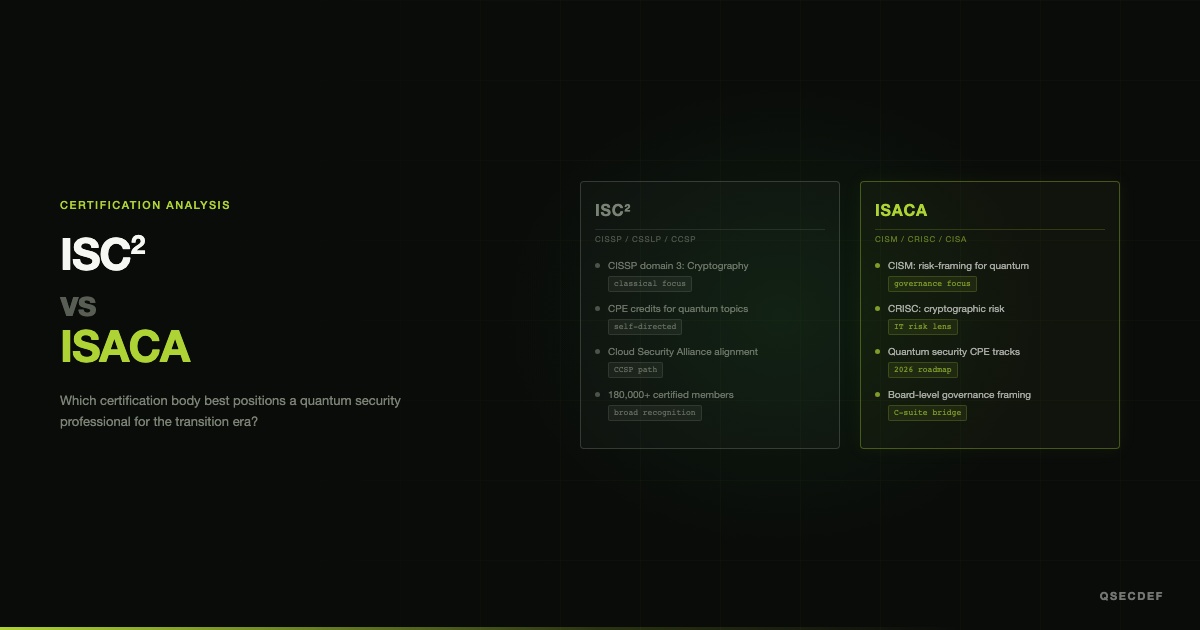
ISC2 vs ISACA: Which Certification Body Should a Quantum Security Professional Use?
The honest answer is that neither body offers what a quantum security professional actually needs. That is not a criticism. It is a statement of timing: NIST finalised ML-KEM, ML-DSA, SLH-DSA, and FN-DSA as standards in August and October 2024. Certification curricula operate on multi-year review cycles. The gap between a regulatory event and a curriculum update is not a failure of governance; it is an arithmetic problem. What follows is a role-by-role assessment of which body's credentials serve quantum security professionals best given where the curricula actually are today, and how the continuing education mechanisms of both bodies can be used to build quantum-specific technical depth in the meantime.
The ISC2 vs ISACA comparison is well-trodden territory in cybersecurity career planning. Most treatments focus on CISSP versus CISM as a function of technical depth versus management focus. That framing remains useful, but quantum security adds a dimension neither credential fully covers. The question for a professional whose primary focus is PQC migration, quantum threat modelling, or HNDL risk assessment is: which credential best signals professional competence to employers and procurement frameworks, while leaving room to build quantum-specific depth through specialist training?
What ISC2 Offers a Quantum Security Professional
ISC2 is the certifying body for CISSP (Certified Information Systems Security Professional), CCSP (Certified Cloud Security Professional), SSCP (Systems Security Certified Practitioner), and a small set of concentrations including ISSAP and ISSEP. CISSP is the flagship credential, and it is the one most relevant to this comparison.
CISSP covers eight domains across its Common Body of Knowledge (CBK). The most recent CBK revision cycle, completed in 2024/2025, added explicit acknowledgement of post-quantum cryptography in Domain 3 (Security Architecture and Engineering), referencing the NIST PQC finalisation and the migration imperative. Verify the current depth of PQC coverage against the ISC2 CISSP exam outline at isc2.org/certifications/cissp/cissp-certification-exam-outline before relying on this characterisation. Prior versions addressed quantum computing only in passing. The 2024/2025 update is the first serious attempt by ISC2 to integrate the post-quantum transition into the CISSP curriculum.
What that means in practice: a candidate who passed the CISSP exam in 2024/2025 or later will have encountered post-quantum cryptography as a CBK topic. They will have some familiarity with the concept of quantum-vulnerable asymmetric algorithms and the general case for migration. They will not, in most cases, have studied the mathematical structure of ML-KEM, the construction of hybrid key exchange under IETF RFC 9496, or the practical steps of a CBOM-based migration programme. CISSP is a broad credential. Breadth is its purpose.
The eligibility requirements are straightforward: five years of paid professional experience in two or more of the eight domains, or four years with a qualifying degree in computer science, information security, or a related discipline. Alternatively, candidates can pass the exam and become an Associate of ISC2 while accumulating experience. This is a proven path for security professionals transitioning into new specialisms.
CPE maintenance is 120 credits over three years, or approximately 40 per year. Quantum security workshops, specialist courses, and relevant conferences qualify as CPE provided they meet ISC2's professional relevance criteria. The CPE mechanism matters: a CISSP holder who maintains their credential while building quantum-specific depth through external specialist training is following the most efficient professional development path available today.
CCSP (Certified Cloud Security Professional) is worth noting separately. Cloud key management systems are among the first enterprise components requiring PQC migration. AWS KMS, Azure Key Vault, and GCP Cloud KMS are all active deployment environments for hybrid key exchange. CCSP covers Domains 3 and 4 (Cloud Platform and Infrastructure Security; Cloud Application Security), both of which include cryptographic management. For a cloud security professional leading a PQC migration for cloud-hosted workloads, CCSP is the more precisely targeted ISC2 credential.
What ISACA Offers a Quantum Security Professional
ISACA's portfolio includes CISA (Certified Information Systems Auditor), CISM (Certified Information Security Manager), CRISC (Certified in Risk and Information Systems Control), CGEIT, and CDPSE. The two credentials most relevant to quantum security roles are CISM and CISA.
CISM covers four domains: Information Security Governance, Information Security Risk Management, Information Security Programme, and Incident Management. None of these domains address cryptography at the algorithm level. That is not a shortcoming of CISM; it is a description of what the credential is for. CISM is a management and governance credential. A CISM holder overseeing a PQC migration programme will manage the governance structure, the budget, the risk register, and the programme delivery milestones. They will not be selecting between ML-KEM-768 and ML-KEM-1024, or deciding whether SLH-DSA or ML-DSA better suits their signing infrastructure. CISM signals that the holder can manage the programme. Technical algorithm selection sits with the security architects.
CISA's scope is audit and assurance. For quantum security, CISA holders have a specific and valuable role: auditing whether an organisation's cryptographic risk management process meets its obligations under NIST IR 8547 (November 2024), assessing whether a CBOM has been constructed and maintained, and evaluating the governance controls around a PQC migration programme. An organisation that wants independent assurance that its quantum migration programme is adequately governed and on track wants a CISA-qualified auditor. That use case is real and growing as regulatory pressure around PQC compliance builds.
ISACA introduced a Quantum Computing Fundamentals Certificate in 2024. It is a short course providing awareness-level education on quantum computing concepts for IT professionals without a technical quantum background. Verify current CPE eligibility and course details against ISACA's website before publication, as ISACA may have updated its CPE policy or course description since the knowledge cutoff. It is not a career credential in the same category as CISM or CISA, and it is awareness-level rather than practitioner-level. It is best understood as orientation for professionals who need to understand why quantum computing matters to their security programme, not as a foundation for technical quantum security work.
CPE requirements for CISM and CISA are 120 hours over three years, with a minimum of 20 hours per year. Verify whether CISM and CISA carry the same per-credential annual minimum against current ISACA guidance, as requirements may differ by credential. Quantum security training qualifies for CPE across both bodies, subject to professional relevance. Both bodies charge annual maintenance fees; check current rates on each body's official website.
The Quantum Gap in Both Curricula
As of 2026, neither ISC2 nor ISACA offers a standalone quantum security certification. For a broader view of the certification landscape across quantum and cybersecurity, see the guide to cybersecurity certifications in the quantum era. The quantum-specific technical content that a practitioner needs for hands-on PQC work, algorithm selection criteria, hybrid scheme construction, CBOM methodology, HNDL threat modelling, QKD deployment constraints, the distinction between ML-KEM and FN-DSA use cases, is not covered at depth in CISSP, CISM, CISA, or CRISC. That is the current state of the curricula, stated plainly.
The NIST PQC standards (FIPS 203, FIPS 204, FIPS 205, and FIPS 206) were published in August and October 2024. Neither certification body can be expected to have restructured a curriculum around standards that finalised eight months before the assessment period in question. The CISSP CBK 2024/2025 update is the earliest substantive response from either body. Both are expected to develop more specific quantum security content as the regulatory compliance landscape matures, likely over the next two to three years. This is a professional judgement estimate, not a stated position from either body.
The practical consequence of this gap is that professional development in quantum security requires two components running in parallel: the established credential that signals professional maturity and appears on HR systems and procurement frameworks (CISSP, CISM, CISA, or CRISC, depending on role), and specialist quantum security training that builds the technical depth neither curriculum currently provides. The CPE frameworks of both bodies create the mechanism: quantum security workshops, practitioner-level courses, and relevant conferences qualify for CPE from both ISC2 and ISACA, making them complementary to credential maintenance rather than competing with it.
Which Credential Fits Which Quantum Security Role
Role fit is the right frame for this comparison, because "which body is better?" is the wrong question. The correct question is: what does your professional function require, and which credential best signals competence in that function to the organisations you work with?
For a security architect or cryptographer leading hands-on PQC migration work, neither CISSP nor CISM substitutes for specialist training. CISSP signals broad professional security competence and domain experience across the eight CBK areas; it does not signal PQC technical depth. A CISSP-qualified security architect with specialist quantum training is a strong professional profile because the credential provides employer recognition while the specialist training provides the actual capability. The technical migration skills a security architect needs are detailed in the post-quantum cryptography guide for security architects. CCSP is worth adding for architects whose PQC migration scope centres on cloud key management infrastructure.
For a CISO or security programme manager overseeing a PQC migration programme, CISM is the more precisely aligned governance credential. Its four domains map directly to the governance, risk management, programme delivery, and incident management dimensions of a PQC migration programme. CISSP's broader technical coverage may provide additional utility for CISOs who want to engage with technical decisions, but CISM's management focus aligns more naturally to the programme oversight role.
For a security auditor or compliance manager assessing whether an organisation's quantum security posture meets its regulatory obligations, NIST IR 8547 alignment, FedRAMP PQC requirements and CMMC compliance (US defence and federal supply chain), or NCSC guidance adherence (UK entities), depending on their organisation's jurisdiction and regulatory context, CISA is the most directly relevant credential. CISA holders are specifically trained to evaluate cryptographic risk management processes and assess whether the governance controls around a migration programme are adequate.
For board-level or executive professionals requiring structured quantum security education, neither body currently offers a dedicated quantum credential at the executive level. Verify against current ISC2 and ISACA offerings before publication, as either body may have announced or launched a quantum-specific credential between knowledge cutoff and May 2026. ISACA's Quantum Computing Fundamentals Certificate is awareness-level. Executive-level quantum security development is currently delivered through specialist providers.
CPD Requirements and How Quantum Training Fits
Both ISC2 and ISACA operate on a three-year maintenance cycle requiring 120 CPE credits or hours. ISC2 uses the term "CPE" (Continuing Professional Education); ISACA uses CPE hours. The practical annual requirement is similar: approximately 40 hours per year for ISC2, with a minimum of 20 hours per year for ISACA (both total to 120 over three years).
Quantum security courses, workshops, and conferences are eligible CPE activities under both bodies provided they are relevant to the holder's professional role. This is not a theoretical advantage. A security professional who holds CISSP and attends a specialist two-day PQC migration workshop can apply that time toward CPE. A CISM holder who completes a structured quantum risk assessment programme can apply it toward their CPE hours. Both bodies require attestation of genuine professional relevance; quantum security qualifies clearly for any holder whose role involves cryptography, risk management, or information security programme leadership.
The practical recommendation that follows from the CPE structure: maintain the credential most aligned to your current role and career stage, and use the CPE mechanism to build quantum-specific depth through specialist providers. Replacing an existing credential with something "more quantum" is not a path available through either body today. Building quantum depth alongside the existing credential is.
The Practical Recommendation
There is no single credential that simultaneously satisfies the employer-recognition function, the HR-system-visibility function, and the quantum-technical-depth function. That combination does not exist in either body's current portfolio. The practical path is a combination: the credential appropriate to your role, plus specialist quantum security training to build the depth neither body currently provides.
If you hold CISSP: the 2024/2025 CBK update has introduced quantum/PQC content into the curriculum you are already maintaining. Continue maintaining CISSP for its employer recognition value. Use quantum security specialist training, practitioner-level courses, NIST FIPS-referenced programmes, hands-on migration workshops, to build technical depth. Apply qualifying training toward CPE.
If you hold CISM and manage security programmes: the governance and risk management framework CISM provides is directly applicable to overseeing a PQC migration programme. CISM does not require augmentation with a technical quantum credential; it requires augmentation with an understanding of what quantum risk means for programme governance, risk registers, and stakeholder reporting. Targeted specialist training serves that purpose.
If you are choosing a first certification with a quantum security career in mind: the role-based framework above applies. Technical security architect roles are better served by CISSP (with specialist training); programme and governance roles by CISM; audit and compliance roles by CISA. Verify that neither ISC2 nor ISACA has launched a standalone quantum security certification between August 2025 and publication; if either has done so, the core gap argument in this article requires revision.
Both bodies are expected to develop more specific quantum security content as the regulatory landscape consolidates. In the meantime, specialist quantum security training from practitioners working directly with NIST FIPS 203/204/205/206 and the NCSC migration guidance provides the technical depth that neither body's current curriculum reaches.
Sources: ISC2 Certifications overview, isc2.org/certifications (2026); ISC2 CISSP Certification Exam Outline 2024/2025; ISC2 CPE Handbook (2024); ISC2 CCSP Exam Outline (2024); ISACA Credentialing overview, isaca.org/credentialing (2026); ISACA CISM Exam Content Outline 2024; ISACA CISA Exam Content Outline 2024; ISACA Quantum Computing Fundamentals Certificate (2024); ISACA CPD Policy (2026); NIST FIPS 203/204/205/206, August-October 2024; NIST IR 8547, November 2024 (doi:10.6028/NIST.IR.8547).