








Leadership Bootcamp · Cohort starts 1 December 2026
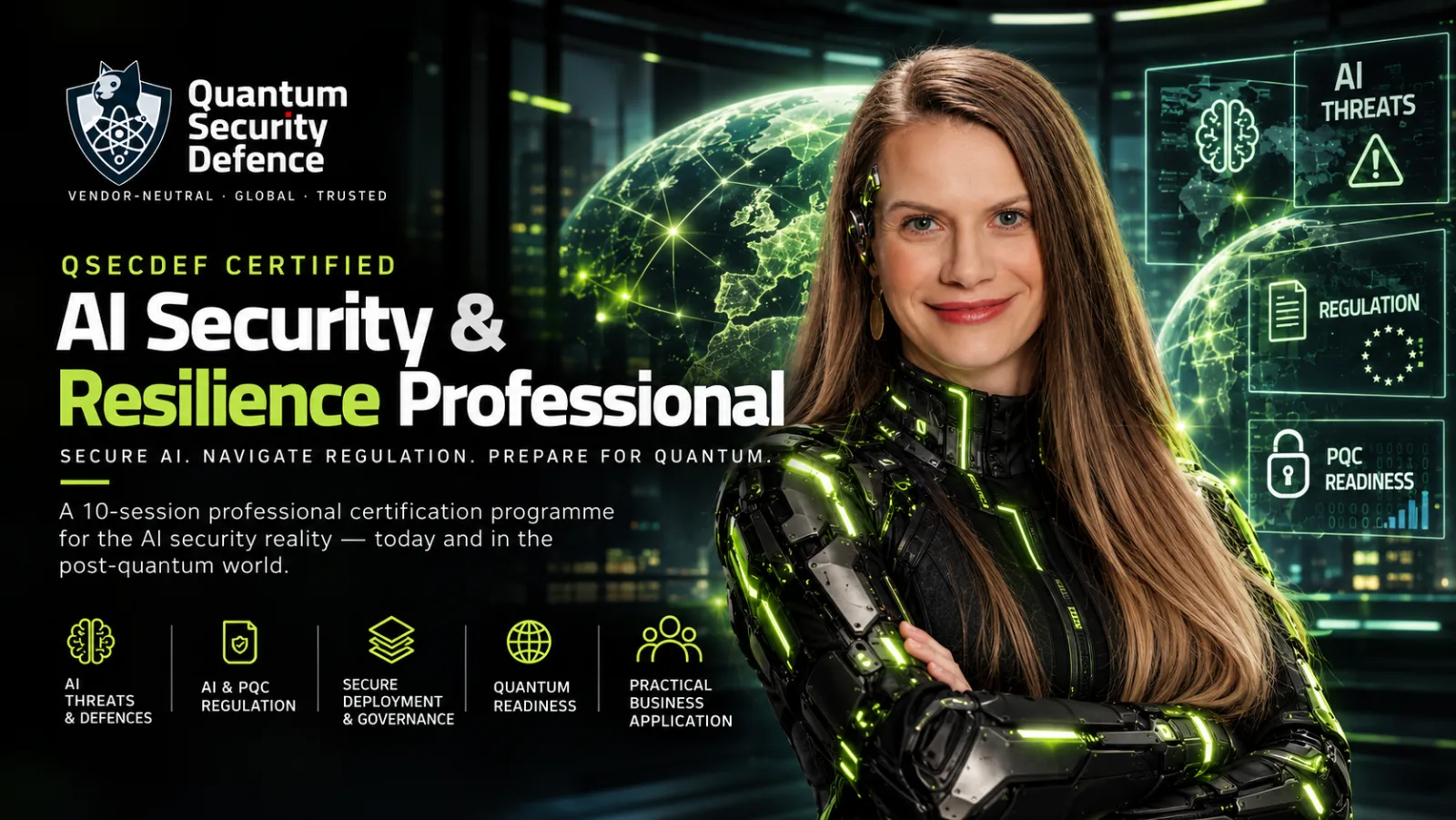
QSECDEF AI Security & Resilience Leadership Bootcamp
Members may sit the Certified AI Security & Resilience Professional (CASRP)
Secure AI. Navigate regulation. Prepare for quantum. No prior experience required.
Artificial intelligence is no longer a technology choice confined to one team. It shapes decisions, handles sensitive information, connects to suppliers and acts on behalf of users, and it sits on cryptographic foundations that are approaching the end of their useful life. Leaders are being asked to approve, govern and defend AI systems they did not design, under regulation that is still being written.
A ten-week professional programme for the people who have to make AI decisions that hold up. Ten live online sessions on Tuesdays, with two 40-minute lectures in each session. That is twenty lectures in total. Evidence-led and vendor-neutral. No background in cryptography, quantum physics or AI engineering is required.
Free to attend. Every weekly session is free and open to all. QSECDEF members receive an attendance certificate for each session and can earn the Certified AI Security & Resilience Professional (CASRP) credential.
Register for the free live sessions. Joining details and a reminder arrive by email before each Tuesday session.
Live online, Tuesdays 16:30 to 18:30 CET. No card required.
The complete 10-week AI security and resilience programme
Learning outcome. By the end of the programme members are able to explain how AI security, enterprise risk, organisational resilience and post-quantum readiness connect, describe what is changing in each area and why it matters, identify the questions to ask of providers, suppliers and internal teams, and recognise where stronger organisational action and governance may be needed.
Every session is free and open to the public. Each session has two 40-minute lectures, with no workshops or scenario exercises required.
Members may receive an attendance certificate for every session attended. Members who complete all ten sessions, which cover all twenty lectures, may also sit the CASRP final examination. If you would like to receive certificates of attendance and sit the programme level certification you will need to be a member of QSECDEF.
Course Schedule and Contents
Dates and times. Sessions run weekly on Tuesdays, 16:30 to 18:30 CET: 1, 8, 15 and 22 December 2026, then, after a break on 29 December and 5 January, 12, 19 and 26 January and 2, 9 and 16 February 2027.
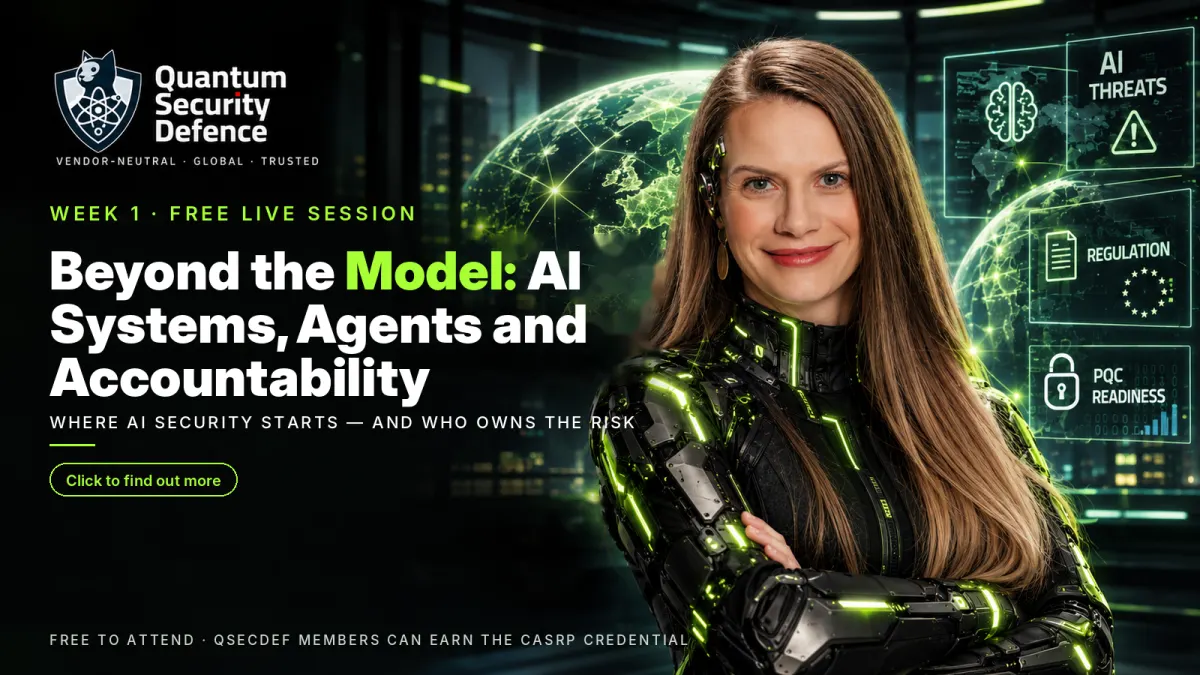
Beyond the Model: AI Systems, Agents and Accountability
Tuesday 1 December 2026 · 16:30 to 18:30 CET
Free live session
Beyond the Model: AI Systems, Agents and Accountability
Tuesday 1 December 2026 · 16:30 to 18:30 CET
Week 1: AI Security: Capabilities, Risk, Accountability and Regulatory Landscape
Lectures this session
- Lecture 1.1: Beyond the Model: AI Systems, Agents and Their Security Boundaries
- Lecture 1.2: AI Risk and Accountability: Responsibilities Before Deployment
Introduce the whole programme. Establish what modern AI systems are made of, where their security boundaries sit, why AI is an enterprise risk and who is accountable before deployment. Regulation is introduced here as a landscape and examined in depth in Week 9.
Beyond the Model: AI Systems, Agents and Their Security Boundaries
An AI system is far more than a model. It combines training and retrieval data, prompts, tools, APIs, orchestration, hosting and suppliers, and increasingly agents that plan and act. This opening lecture provides the map the rest of the programme follows: every later week examines one part of it.
AI Risk and Accountability: Responsibilities Before Deployment
AI can affect decisions, sensitive information, customers and operations, and it can enter an organisation through formal procurement, embedded software or individual use. This session reframes AI as an enterprise system with accountable owners, and shows how context and evidence matter when deciding whether and how to deploy it.
Learning outcome
By the end of this session you will be able to describe the components of an AI system, identify where its security boundaries sit, distinguish the responsibilities of providers, deployers and data owners, and list the leadership questions to answer before deploying AI.
Who should attend?
CISOs and security architects, AI and technology leaders, risk, governance and compliance professionals, programme managers and anyone responsible for approving or overseeing AI adoption.
Who can attend?
Anyone may attend the free weekly sessions. No prior experience is required, and no background in cryptography, quantum physics or AI engineering is needed.
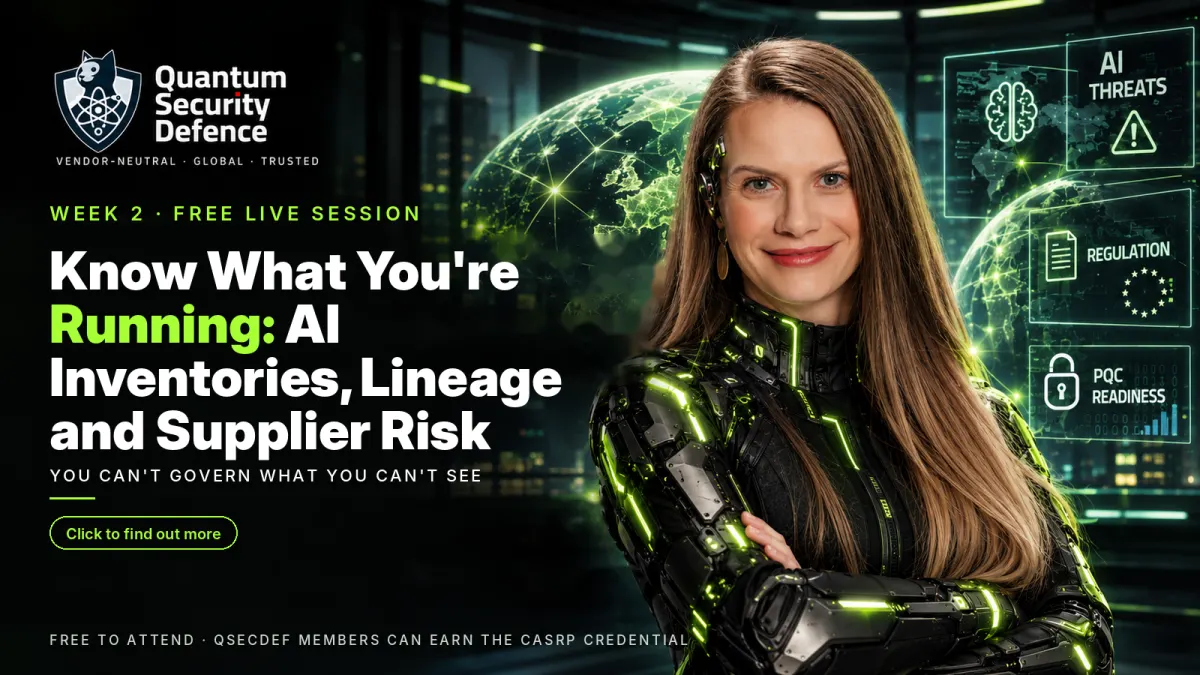
Know What You're Running: AI Inventories, Lineage and Supplier Risk
Tuesday 8 December 2026 · 16:30 to 18:30 CET
Free live session
Know What You're Running: AI Inventories, Lineage and Supplier Risk
Tuesday 8 December 2026 · 16:30 to 18:30 CET
Week 2: AI supply chains, asset visibility and vendor risk
Lectures this session
- Lecture 2.1: Know What You're Running: AI Inventories, Model Lineage and AI-BOMs
- Lecture 2.2: Buying AI Safely: Supplier Due Diligence, Contracts and IP Risk
Make AI dependencies visible and strengthen procurement, lifecycle and supplier oversight.
Know What You're Running: AI Inventories, Model Lineage and AI-BOMs
Organisations cannot reliably govern systems they cannot identify. The session covers models, code, data sources, interfaces and dependencies for security teams and owners who need traceability and repeatable review.
Buying AI Safely: Supplier Due Diligence, Contracts and IP Risk
Supplier contracts influence data use, incident handling, liability and exit options. This session gives procurement, legal, security and business owners a common set of topics without treating any clause as universally sufficient.
Learning outcome
By the end of this session you will be able to explain AI asset inventories and bill-of-materials approaches, identify the components to track, and list the security, privacy, intellectual-property and continuity questions to put to any AI supplier.
Who should attend?
Security architects, technology and data leaders, procurement and supplier-risk managers, legal and privacy teams, and governance specialists.
Who can attend?
Anyone may attend the free weekly sessions. No prior experience is required, and no background in cryptography, quantum physics or AI engineering is needed.
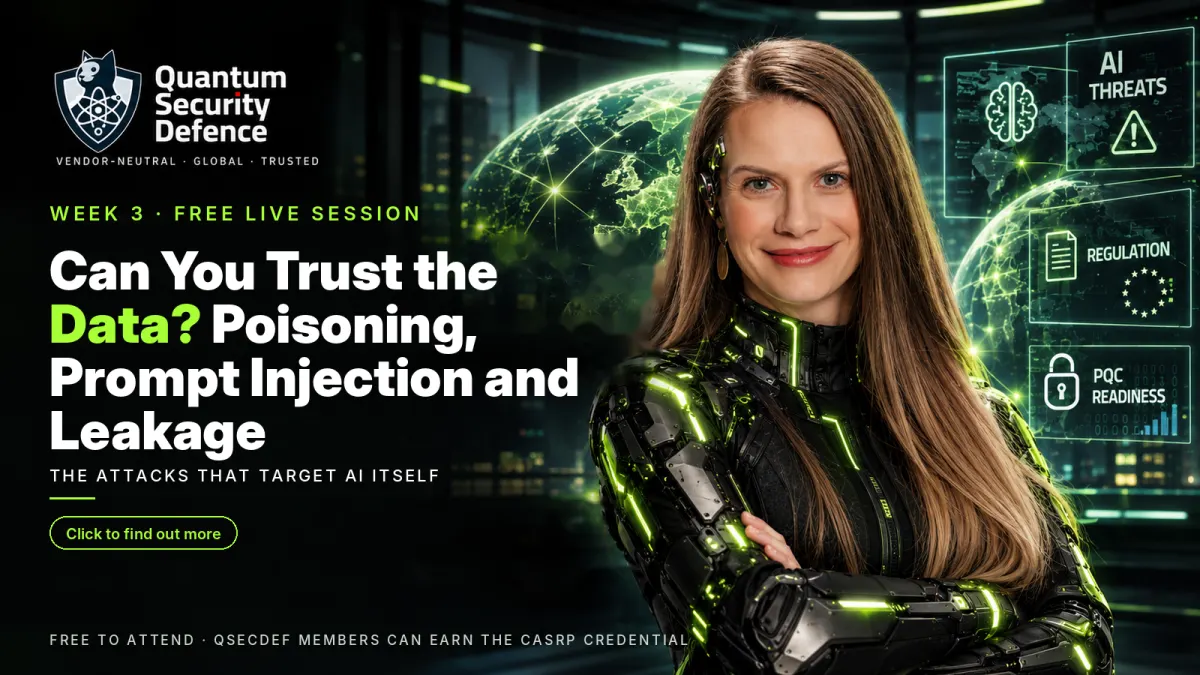
Can You Trust the Data? Poisoning, Prompt Injection and Leakage
Tuesday 15 December 2026 · 16:30 to 18:30 CET
Free live session
Can You Trust the Data? Poisoning, Prompt Injection and Leakage
Tuesday 15 December 2026 · 16:30 to 18:30 CET
Week 3: AI vulnerabilities: data poisoning, prompt injection and information disclosure
Lectures this session
- Lecture 3.1: Can You Trust the Data? Poisoning, Provenance and Ingestion Controls
- Lecture 3.2: Prompt Injection and Data Leakage: Controlling What AI Can Do
Explain practical AI attack paths and controls that reduce likelihood and impact.
Can You Trust the Data? Poisoning, Provenance and Ingestion Controls
AI behaviour depends partly on data used to train, fine-tune, retrieve or operate a system. The risk depends on design and attacker access; this session is relevant to data owners, AI engineers and assurance teams.
Prompt Injection and Data Leakage: Controlling What AI Can Do
Prompt injection can influence how an application interprets instructions or retrieved content. Risk increases when the system connects to confidential data or action-taking tools. No single prompt or filter reliably eliminates it.
Learning outcome
By the end of this session you will be able to describe data-poisoning and prompt-injection risks, explain why model instructions are not a security control, and identify layered controls that limit what an AI system can access and do.
Who should attend?
AI and data professionals, security engineers and architects, application owners, CISOs and technology-risk teams.
Who can attend?
Anyone may attend the free weekly sessions. No prior experience is required, and no background in cryptography, quantum physics or AI engineering is needed.
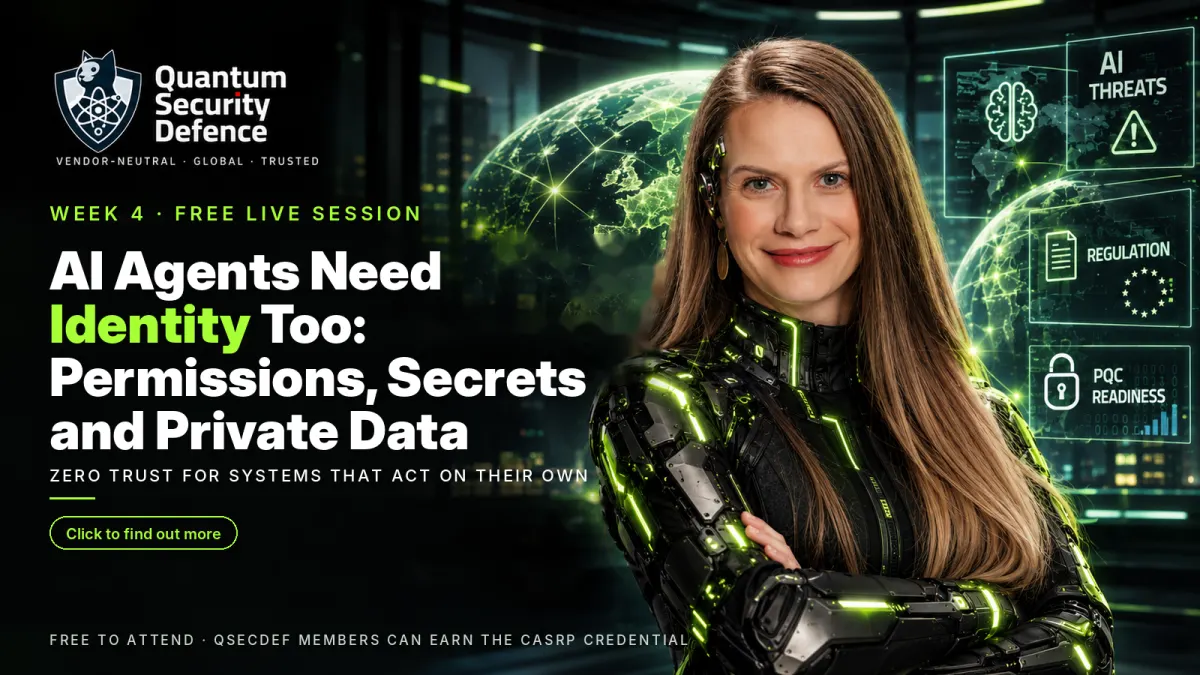
AI Agents Need Identity Too: Permissions, Secrets and Private Data
Tuesday 22 December 2026 · 16:30 to 18:30 CET
Free live session
AI Agents Need Identity Too: Permissions, Secrets and Private Data
Tuesday 22 December 2026 · 16:30 to 18:30 CET
Week 4: AI agents, identity, permissions and private-data access
Lectures this session
- Lecture 4.1: AI Agents Need Identity Too: Permissions, Secrets and Zero Trust
- Lecture 4.2: Private Data in AI: Securing RAG, Vector Databases and Retrieval
Address risks when AI reaches internal systems, retrieves documents or acts on behalf of users.
AI Agents Need Identity Too: Permissions, Secrets and Zero Trust
Agents can invoke tools, access APIs and perform tasks previously requiring a person or service account. Their privileges need deliberate design and monitoring.
Private Data in AI: Securing RAG, Vector Databases and Retrieval
RAG retrieves organisational information to inform responses, but does not automatically make data private or enforce authorised access. This matters for internal knowledge assistants and data-connected applications.
Learning outcome
By the end of this session you will be able to explain identity and access-management principles for AI agents, identify the controls that limit the impact of a compromised or misused agent, and describe the main access-control risks in RAG and vector-search pipelines.
Who should attend?
Identity and access-management professionals, security architects, AI platform and data teams, cloud-security specialists and application owners.
Who can attend?
Anyone may attend the free weekly sessions. No prior experience is required, and no background in cryptography, quantum physics or AI engineering is needed.
AI in the Attack Chain, and What Quantum Really Changes
Tuesday 12 January 2027 · 16:30 to 18:30 CET
Free live session
AI in the Attack Chain, and What Quantum Really Changes
Tuesday 12 January 2027 · 16:30 to 18:30 CET
Week 5: AI-enabled cyber threats and emerging quantum technologies
Lectures this session
- Lecture 5.1: AI in the Attack Chain: Threats, Defence and the Limits of Automation
- Lecture 5.2: Quantum Computing, Geopolitics and AI Security: What Is Real?
Separate demonstrated AI-enabled cyber activity from emerging research and speculative scenarios.
AI in the Attack Chain: Threats, Defence and the Limits of Automation
AI can support reconnaissance, social engineering, coding assistance and analysis. It can also help defenders with investigation, alert triage, code review and vulnerability prioritisation. Both offensive and defensive uses require evidence, validation and appropriate controls; neither should be treated as universally reliable or fully autonomous.
Quantum Computing, Geopolitics and AI Security: What Is Real?
Quantum computing and quantum machine learning are active research areas, but claims about imminent automated malware, universal speedups or routine quantum-enabled cyberattacks are not established operational facts. At the same time, concentration of advanced compute, models, data and critical suppliers can create genuine strategic dependencies. The priority is proportionate monitoring and cryptographic readiness.
Learning outcome
By the end of this session you will be able to describe credible uses of AI in cyber operations and defence, distinguish increased scale from fundamentally new capability, separate established quantum-computing facts from speculation, and explain how compute and supplier dependencies create strategic risk.
Who should attend?
Cybersecurity leaders, threat-intelligence and SOC teams, security architects, risk professionals, technology executives and policy advisers.
Who can attend?
Anyone may attend the free weekly sessions. No prior experience is required, and no background in cryptography, quantum physics or AI engineering is needed.
Who Owns AI Risk? Governance, HNDL and TNFL
Tuesday 19 January 2027 · 16:30 to 18:30 CET
Free live session
Who Owns AI Risk? Governance, HNDL and TNFL
Tuesday 19 January 2027 · 16:30 to 18:30 CET
Week 6: AI risk governance and long-term resilience
Lectures this session
- Lecture 6.1: Who Owns AI Risk? Governance, Accountability and Enterprise Exposure
- Lecture 6.2: Long-Term Data and Trust: HNDL, TNFL and Quantum Readiness
Connect enterprise AI risk to long-term confidentiality, authenticity and cryptographic resilience. HNDL and TNFL are explained as distinct risk pathways, not interchangeable labels.
Who Owns AI Risk? Governance, Accountability and Enterprise Exposure
AI failures may arise from data, permissions, suppliers, oversight or operational dependencies, not just the model. This session gives leaders a framework for ownership, risk appetite and escalation.
Long-Term Data and Trust: HNDL, TNFL and Quantum Readiness
Harvest Now, Decrypt Later (HNDL) concerns the possible future decryption of retained encrypted information when vulnerable cryptography is involved. Trust Now, Forge Later (TNFL) is shorthand for potential future risks to signature authenticity and trust mechanisms. The conditions and impacts differ; neither implies that all data or signatures are already compromised.
Learning outcome
By the end of this session you will be able to explain how AI risks are owned and escalated across functions, and distinguish future decryption risk from future signature-authenticity risk, identifying why information lifetimes and cryptographic dependencies matter to AI systems.
Who should attend?
CISOs, technology-risk leaders, AI governance professionals, operational-resilience teams, data owners, programme managers and cryptography practitioners.
Who can attend?
Anyone may attend the free weekly sessions. No prior experience is required, and no background in cryptography, quantum physics or AI engineering is needed.
You Can't Migrate What You Can't See: CBOM and PQC Planning
Tuesday 26 January 2027 · 16:30 to 18:30 CET
Free live session
You Can't Migrate What You Can't See: CBOM and PQC Planning
Tuesday 26 January 2027 · 16:30 to 18:30 CET
Week 7: Cryptographic visibility, crypto-agility and PQC migration
Lectures this session
- Lecture 7.1: You Can't Migrate What You Can't See: CBOM and Cryptographic Discovery
- Lecture 7.2: Planning the PQC Transition: Standards, Timelines and Procurement
Move from understanding the risk to a manageable cryptographic migration programme.
You Can't Migrate What You Can't See: CBOM and Cryptographic Discovery
Cryptography is embedded across applications, devices, protocols, certificates, suppliers and services. An inventory helps identify dependencies and difficult replacements.
Planning the PQC Transition: Standards, Timelines and Procurement
PQC migration involves discovery, design, testing, procurement and deployment. The roadmap must reflect the organisation's own estate and obligations; timing varies across systems and suppliers.
Learning outcome
By the end of this session you will be able to describe the purpose of a cryptographic inventory and how a CBOM supports migration governance, identify the main NIST PQC standards, and explain how to translate guidance into a realistic, phased migration roadmap.
Who should attend?
Security architects, infrastructure and PKI leaders, cryptography professionals, CISOs, technology-risk teams, procurement and programme managers.
Who can attend?
Anyone may attend the free weekly sessions. No prior experience is required, and no background in cryptography, quantum physics or AI engineering is needed.
Protecting AI Models, Updates and Agents: Signatures, Provenance, Guardrails
Tuesday 2 February 2027 · 16:30 to 18:30 CET
Free live session
Protecting AI Models, Updates and Agents: Signatures, Provenance, Guardrails
Tuesday 2 February 2027 · 16:30 to 18:30 CET
Week 8: Protecting AI supply-chain integrity, provenance and controlled agents
Lectures this session
- Lecture 8.1: Protecting AI Models, Updates and Data: Signatures, Provenance and Audit Trails
- Lecture 8.2: Guardrails for AI Agents and Collaborative AI: Zero Trust, Limits, Recovery and Secure Data Collaboration
Connect signatures, provenance and tamper-evident records to AI artefacts and data, and show how enforceable boundaries keep AI agents and collaborative AI accountable, without suggesting that PQC or blockchain solves every AI-security problem.
Protecting AI Models, Updates and Data: Signatures, Provenance and Audit Trails
Models, weights, code, configuration and training data move through supply chains. Signatures can help verify origin and detect modification, and provenance records can show how an output was produced, but both depend on secure keys, trusted validation, sound processes and the recognition that the integrity of a record is not the same as the truth of its content.
Guardrails for AI Agents and Collaborative AI: Zero Trust, Limits, Recovery and Secure Data Collaboration
Agents should not be relied on to enforce their own limits. Controls belong in the surrounding systems. Likewise, collaborative AI such as federated learning can support work on sensitive data without centrally collecting it, but does not automatically prevent leakage or misuse. In both cases the design of the boundary, not the technology alone, determines the protection.
Learning outcome
By the end of this session you will be able to explain how signatures, provenance and audit trails verify AI artefacts and data origin, compare distributed ledgers with conventional controls, describe practical methods for constraining agent actions, and distinguish federated learning's goals from the protections of encryption and PQC.
Who should attend?
Product-security teams, AI platform architects, software supply-chain security professionals, data leaders, PQC practitioners and anyone deploying agents or collaborative AI.
Who can attend?
Anyone may attend the free weekly sessions. No prior experience is required, and no background in cryptography, quantum physics or AI engineering is needed.
Regulation Decoded: EU AI Act, CRA, NIS2, DORA and the PQC Timeline
Tuesday 9 February 2027 · 16:30 to 18:30 CET
Free live session
Regulation Decoded: EU AI Act, CRA, NIS2, DORA and the PQC Timeline
Tuesday 9 February 2027 · 16:30 to 18:30 CET
Week 9: Regulation and standards: AI, cyber resilience and cryptographic obligations
Lectures this session
- Lecture 9.1: The AI Regulatory Landscape: EU AI Act, Roles, Obligations and Standards
- Lecture 9.2: Cyber Resilience, Product Security and Cryptographic Obligations: CRA, NIS2, DORA and the PQC Timeline
Having built the technical and organisational understanding, examine in depth the regulatory landscape introduced in Week 1: what is binding, what is guidance, who it applies to and how obligations connect to the controls covered in earlier weeks. All references are educational context, not legal advice.
The AI Regulatory Landscape: EU AI Act, Roles, Obligations and Standards
The EU AI Act is the first comprehensive AI law and the reference point for many organisations, but it sits alongside data protection, product and sector rules, harmonised standards and voluntary frameworks. Leaders need to know which role they occupy, which obligations follow and what evidence demonstrates compliance.
Cyber Resilience, Product Security and Cryptographic Obligations: CRA, NIS2, DORA and the PQC Timeline
AI-enabled systems are also products with digital elements, components of essential services and parts of financial ICT estates. The Cyber Resilience Act, NIS2 and DORA each bring obligations that apply regardless of whether AI is involved, while national and European PQC roadmaps increasingly set expectations for cryptographic migration. This session connects those obligations to the inventories, supplier assurance and migration planning covered in Weeks 2, 6 and 7.
Learning outcome
By the end of this session you will be able to explain the EU AI Act's structure and role-specific obligations, distinguish legal requirements from standards and guidance, identify the main European cyber-resilience obligations relevant to AI-enabled systems, and explain how regulatory timelines shape post-quantum migration planning.
Who should attend?
Governance, risk and compliance professionals, legal and privacy teams, CISOs, AI governance leads, product owners in regulated sectors and advisers to critical-infrastructure organisations.
Who can attend?
Anyone may attend the free weekly sessions. No prior experience is required, and no background in cryptography, quantum physics or AI engineering is needed.
Assuring AI Before Deployment: Red Teaming and the Five Pillars
Tuesday 16 February 2027 · 16:30 to 18:30 CET
Free live session
Assuring AI Before Deployment: Red Teaming and the Five Pillars
Tuesday 16 February 2027 · 16:30 to 18:30 CET
Week 10: Assurance, executive decisions and the Five Pillars of Defensibility
Lectures this session
- Lecture 10.1: Assuring AI Before Deployment: Red Teaming, Testing and Evidence
- Lecture 10.2: The Executive AI Resilience Scorecard: From Risk to a Defensible Decision
Bring the programme together into an executive-friendly approach to assurance and deployment decisions.
Assuring AI Before Deployment: Red Teaming, Testing and Evidence
AI systems need testing that reflects their risks, but red teaming complements conventional penetration testing, secure development, privacy review and operational testing. Decision-makers should understand scope, methods and limitations of the evidence.
The Executive AI Resilience Scorecard: From Risk to a Defensible Decision
The final session brings together AI governance, security, supplier assurance and PQC readiness. The Five Pillars and Traffic Light Matrix are QSECDEF organising frameworks, not external standards, formal certifications or automatic legal protection.
Learning outcome
By the end of this session you will be able to explain AI red teaming's role in wider assurance, identify the evidence decision-makers should review before deployment, and use the Five Pillars and Traffic Light Matrix to communicate risk-based deployment decisions.
Who should attend?
CISOs, CIOs and CTOs, AI governance leaders, technology-risk professionals, programme managers, board advisers and anyone who signs off AI deployments.
Who can attend?
Anyone may attend the free weekly sessions. No prior experience is required, and no background in cryptography, quantum physics or AI engineering is needed.
CASRP final examination
Members, after completing all ten sessions. Pass mark 80%.
Members receive an attendance certificate for every session and sit the final examination.
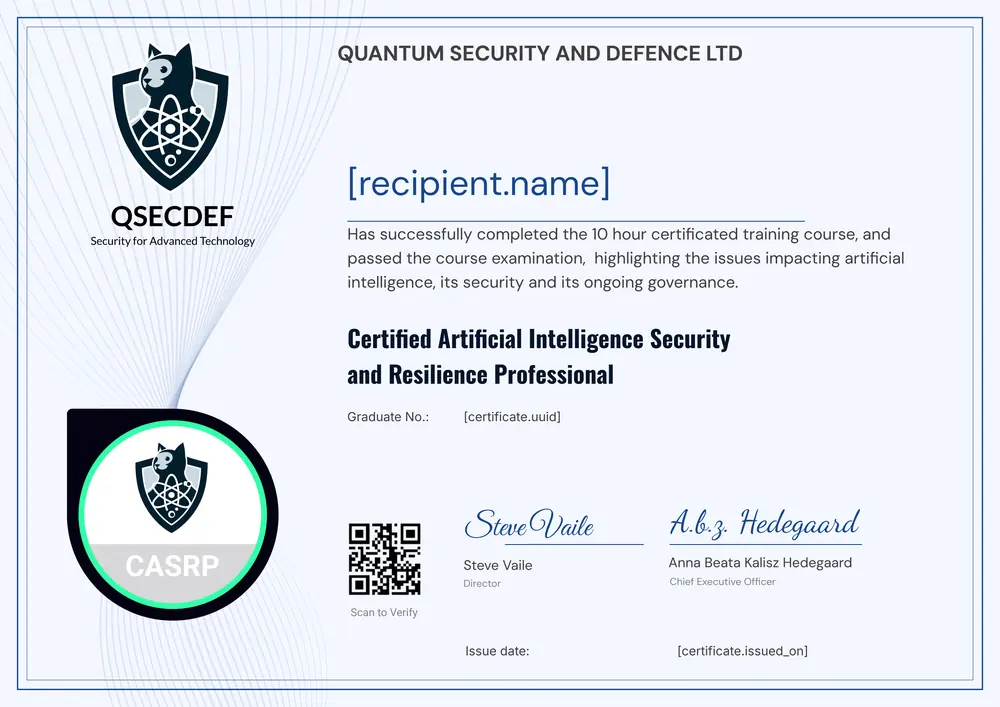
QSECDEF Certified AI Security & Resilience Professional (CASRP)
Complete all ten sessions and pass the final examination to earn the Certified AI Security & Resilience Professional (CASRP) credential. The examination covers the stated learning outcomes and is available to QSECDEF members who have completed the full programme.
The bootcamp is an introductory professional programme and the entry point to the separate QSECDEF AI Risk & Resilience Programme Manager course. It is not a programme-management qualification.
On passing the examination you receive:
- A certificate for your LinkedIn profile
- A digital badge
- An attendance certificate for every session attended
A credential, once awarded, belongs to you. It does not expire with membership and remains verifiable.
- Programme
- 20 lectures across 10 sessions, two per session, live online
- Pass mark
- 80% or higher in the final examination
- Framework
- The Five Pillars of Defensibility: Visibility, Integrity, Resilience, Longevity and Sovereignty
Credentials are issued by Quantum Security and Defence Ltd, in the European micro-credential format.
Who teaches the AI security and resilience training
Meet our quantum security experts for the full team.
What the QSECDEF community says
Posts shared publicly on LinkedIn by members of the QSECDEF community. Each link opens the original post.
Member bonus
Members Bonus - included with your QSECDEF membership
Join as a member and the following courses and benefits are instantly open to you. QSECDEF is a continuous learning experience with real people delving into the hottest, most advanced and most disruptive technology.
- Included in membership
Certified Quantum Business Professional (CQBP)
Who it is forThis ten part bootcamp is for executives, decision-makers, risk and security teams, product and innovation leads that need to understand what Quantum is and why it matters to business.
Module 1 free to trial. Members can earn the CQBP credential.
Your trainerAnna Beata Kalisz Hedegaard
Chief Executive Officer, QSECDEF
LengthAbout 22 hours10 modules, 20 recorded lectures, own pace
CostIncluded in membershipView course - Included in membership
Quantum Cyber Security Foundation
Who it is forCybersecurity teams, technology leaders, procurement and policy staff, and researchers. No quantum physics required. Rapid five hour certification designed to bring teams up to speed.
Certificate issued by QSECDEF. Module 1 free to try.
Your trainerAnna Beata Kalisz Hedegaard
Chief Executive Officer, QSECDEF
- Included in membership
Quantum Resilient Blockchain Foundation
Who it is forBlockchain developers, security teams, investors and fund managers, policy and compliance staff wanting to understand the risk to digital assets.
Certificate issued by QSECDEF.
Your trainerAnna Beata Kalisz Hedegaard
Chief Executive Officer, QSECDEF
- Included in membership
Plus access 170+ Expert Lectures instantly
Who it is forAnyone building quantum literacy: practitioners, researchers and industry leaders. Covers PQC, QKD, QRNG, quantum computing, AI and satellites. A full back catalogue of all previous lectures from world experts.
Full archive included. New live lecture every week.
LengthAbout 40 minutes eachWatch what you need, when you need it
CostIncluded in membershipView Expert LecturesRecent guest lecturers
Marc KaplanOpen-Source Quantum Communication Systems
Owen O'DonnellContinuous Testing for Post-Quantum Cryptography
Ashish JanghelPost-Quantum Authorisation for D-Apps
Ignazio PedoneCloud Security in the Post-Quantum Era
Cierra ChoucairQKD vs PQC: Market Trends
Vinay KumarQuantum Internet and Routing Protocols
Dr Erik BeckertPackaging for Photonic Quantum Systems
Egon AstraUser Experience with BB84 QKD Devices
Adrian NealOTP-Grade Irreversibility in Encryption
- Included in membership
People Power
Benefit from the best deep tech community on the internet. A flat peer network, cross disciplined, cross industry, cross culture of professionals ensuring quantum technology adoption is safe for our society.
A modern movement of real people, 1500+ QSECDEF members represent more than 900 enterprise organisations, academic centres, research centres and cyber organisations in more than 40 countries that are sharing critical information on QSECDEF.
One membership. Every course.
Members get the CASRP pathway plus the complete QSECDEF training catalogue: the quantum business bootcamp, both foundation certifications, 170+ expert lectures and the weekly community call.
What you get as a member
Membership puts the courses, the lecture library, the weekly call and the people behind them in one place, with 25% off partner training and events.

Access our QSECDEF Training Courses
Your membership includes the introductory quantum cyber security and quantum resilient blockchain courses, plus the Business Bootcamp. Each ends in a certificate, so your team can study at its own pace and show what it completed.
See the courses
Access over 170 expert lectures
More than 170 lectures from practising experts sit in the member library. Topics run from post-quantum cryptography and QKD to sensing, PNT and quantum business. Watch when your diary allows, then return to the ones you need.
Browse the lectures
One new training course live every 90 days
We commit to publishing a new training course every 90 days, so the programme keeps pace with the field. Your membership covers each one as it goes live, with no extra fee for the course.
See current courses
Discounts on partner delivered courses and certifications
Members save 25% on partner training and certifications, including the CPQCPM Post Quantum Cryptography Programme Manager certification. The discount applies at booking, so the saving comes before you pay.
View the certification
In person events invitations, members only event invitations
Members receive invitations to our in-person events, including our London, Amsterdam and Berlin events, plus private members-only briefings and priority access to the QSECDEF members’ symposium 2027 in Paris.
See upcoming events
Priority access for our weekly live call every Tuesday
Every Tuesday at 3pm CET, a practitioner presents a live topic and takes questions. Members get priority access to the call and the recorded archive afterwards, so a missed week is never lost.
Join Tuesday's call
Access a peer network of experts, practitioners and learners
Join 1,500+ members across 40+ countries and 900+ organisations. The community directory and learning management system are open for you instantly on membership, so you know whose profile to open when you need a second opinion.
Meet the experts
Discounts on partner events, workshops and tradeshows
Partner events cost members 25% less. Membership also brings discounted rates on in-house workshops and priority access to QSECDEF annual events, including the Paris Symposium.
See membership benefits
Focus on human interaction
Quantum security is decided by people. Ask your question live on Tuesday's call, put it to a speaker at a members' briefing, or shake hands at the London and Paris events. A human answers.
See how we meet
Global access
Members work in more than 40 countries. The 2026 symposium speakers came from NATO STO, the European Commission, Nokia, Rheinmetall and MBDA. See which organisations sit in the network.
View member organisations
Why membership?
All four courses and 170+ lectures included
Find the right membership for you
Become a memberSTO Summer School: Dual-use quantum technologies
ChannelNATO Science & Technology Organization
We are delighted to collaborate and share our knowledge with STO Summer School on Dual-use quantum technologies. Play the video to find out more.
AI Security & Resilience Leadership Bootcamp: common questions
What is the AI Security & Resilience Leadership Bootcamp?
An introductory, membership-included professional programme that connects AI security, enterprise risk, organisational resilience and post-quantum readiness. It helps professionals understand what is changing, why it matters, what questions to ask and where stronger organisational action may be needed. Ten weekly sessions, each with two 40-minute lectures, twenty lectures in total, live online.
Who is the bootcamp for?
Cybersecurity professionals and security architects; AI, data and technology leaders; governance, risk and compliance professionals; programme managers; PQC and cryptography practitioners; supplier-risk, procurement, privacy and legal teams; and advisers working with regulated or critical-sector organisations.
How long does the bootcamp take?
Ten sessions, one a week, with two 40-minute lectures in each session. That is twenty lectures in total. Sessions run live online on Tuesdays from 16:30 to 18:30 CET: 1, 8, 15 and 22 December 2026, then, after a break over the New Year, 12, 19 and 26 January and 2, 9 and 16 February 2027.
Do I need a technical background?
No. Anyone may attend the free weekly sessions. No prior experience is required, and no background in cryptography, quantum physics or AI engineering is needed.
Is the bootcamp free?
Every weekly session is free and open to all. QSECDEF members receive an attendance certificate for each session they attend, and members may sit the final examination.
What certification do I get?
Members who complete all ten sessions and score 80% or higher in the final examination are awarded the QSECDEF credential Certified AI Security & Resilience Professional (CASRP), with a certificate for their LinkedIn profile and a digital badge.
Is this a programme-management qualification?
No. The bootcamp is an introductory professional programme and the entry point to the separate QSECDEF AI Risk & Resilience Programme Manager course, a five-week, ten-hour course for people who need to organise and manage the organisational response. It does not claim that participants have completed a professional programme-management qualification.
How do we assure quality?
Our courses are developed with reference to the European Quality Assurance Reference Framework for Vocational Education and Training (EQAVET), the European Council Recommendation on micro-credentials and the CAST Universal Design for Learning Guidelines. These are the frameworks we measure ourselves against; we publish our gap assessment and the actions we are taking against it.
Every learner is asked for feedback at the end of a course, and that feedback is reviewed when the course is next revised. Pricing, refund terms and our privacy practice are published in the Trust Centre before you buy.
How can you correct us?
If you find an error or omission in any QSECDEF course or lecture, tell us. We acknowledge every report within five working days, correct the material, record the change in a published change log and tell learners who certified on the affected content. Our community of more than 1,500 members in over 40 countries is our review panel, and we credit reporters who wish to be named.
How does QSECDEF manage its educational standard?
Credentials are issued by Quantum Security and Defence Ltd, in the European micro-credential format. A credential, once awarded, belongs to you. It does not expire with membership and remains verifiable.
QSECDEF credentials are professional certifications issued by QSECDEF. They are not regulated university or educational qualifications. Courses are developed with reference to the European Quality Assurance Reference Framework for Vocational Education and Training (EQAVET), the European Council Recommendation on micro-credentials and the CAST Universal Design for Learning Guidelines. These are the frameworks we measure ourselves against. We have taught our courses at leading organisations, and many of our courses and lectures are delivered by recognised PhD-level professors, doctors or recognised industry practitioners from within the community of peers.
Education standards guidance
We take guidance from the following open frameworks for technical education: EQAVET, the European Quality Assurance Reference Framework for Vocational Education and Training; the European Union Council Recommendation on micro-credentials; the CAST Universal Design for Learning Guidelines; and WCAG 2.2, the web accessibility standard. Educational oversight: QSECDEF Advisory Board. Feedback, errors, omissions and updates: QSECDEF Community.
Alongside the bootcamp, the free weekly quantum security webinar runs every Tuesday at 3pm CET. Open to all registrants.
Register for the live sessions
Cohort starts Tuesday 1 December 2026. Joining details arrive by email before each session.