
Manufacturing and Quantum Risk: Securing Industrial Control Systems
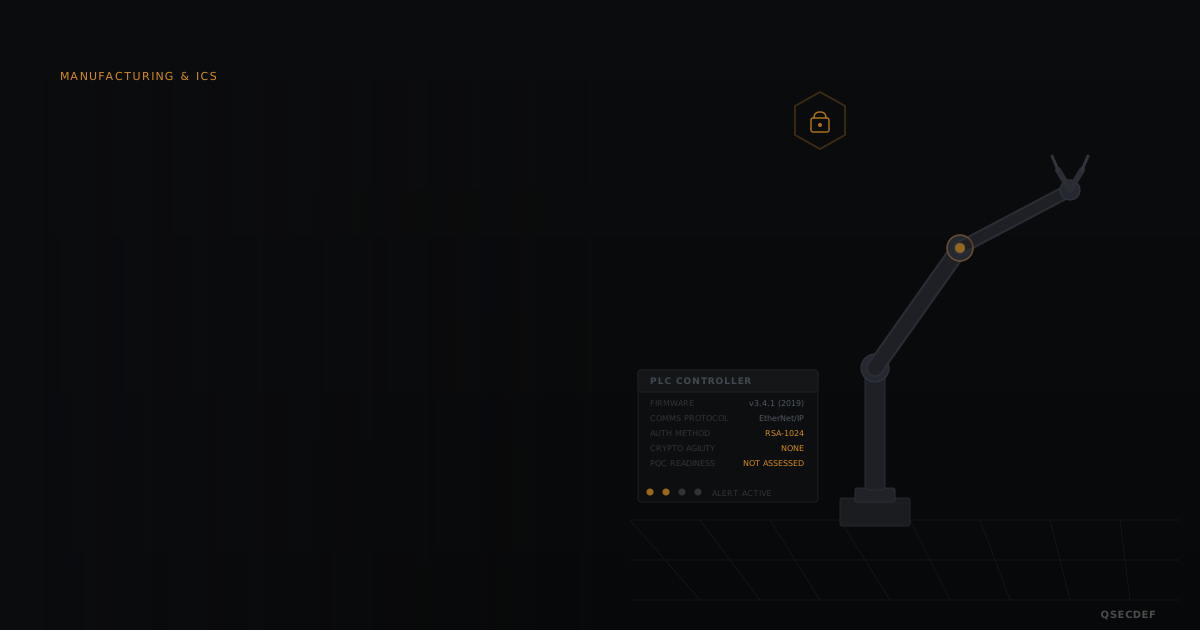
Manufacturing ICS carries two distinct categories of quantum risk, and most ICS security programmes address neither. The first is cryptographic: authentication protocols on PLCs, OPC UA connections, and MES integrations use RSA and ECDSA that Shor's algorithm will break on a cryptographically relevant quantum computer. The second is informational: intellectual property held in CAD files, proprietary process parameters, and design archives has a commercial sensitivity lifetime of 30 years or more, and that data is being transmitted today over connections that a CRQC will retroactively decrypt.
These are different problems requiring different responses. The cryptographic exposure affects operational systems and authentication infrastructure. The informational exposure affects competitive position over a multi-decade horizon in a way that does not trigger any operational alert, does not interrupt production, and will not be visible as a breach until a competitor's product arrives on the market looking very familiar.
The dual framing is deliberate. Automotive manufacturers, aerospace component suppliers, and pharmaceutical production operations are not simply "industrial" in the generic sense used in most OT security literature. They hold IP with defined legal protection periods of 25 years under EU community design law, and trade secret protection that is perpetual where information remains undisclosed. A PQC programme that addresses only the authentication layer but ignores the HNDL exposure of the data those connections carry has addressed the less consequential of the two risks.
The ICS attack surface in manufacturing
PLC and MES architecture: the cryptographic map
Manufacturing ICS operates across three layers with different cryptographic profiles. At field level (Purdue Levels 0-1), PLCs, drives, and sensors use Modbus/TCP (no native authentication), PROFINET (process data secured via TLS at the gateway), and EtherNet/IP with optional CIP Security extension. Native cryptography at field level is rare in pre-2020 deployments. The field bus itself is not where the quantum exposure sits for most manufacturing operations.
At control level (Level 2), SCADA systems, DCS, HMI, and process historians communicate via OPC DA (DCOM, no TLS) or OPC UA (certificate-based TLS with X.509 and RSA or ECDSA). This is where the primary quantum-vulnerable authentication exists. At manufacturing execution level (Level 3), MES systems from Siemens, Dassault, and others integrate with ERP via TLS-protected API calls using RSA or ECDSA certificates. These are the connections that carry both operational data and, in many configurations, IP-adjacent data that feeds production scheduling and quality systems.
OPC UA as the migration target
OPC UA (IEC 62541) is the dominant ICS communications standard in modern manufacturing. Its security model, defined in OPC 10000-2, uses X.509v3 certificates for authentication and TLS for transport. The certificate profiles historically supported RSA-2048-SHA256 (deprecated in OPC UA 1.05) and RSA-4096-SHA512; more recent versions add ECC profiles using P-256 and P-384.
ECC profiles are an improvement over RSA-2048 for classical security but are not post-quantum resistant. P-256 and P-384 are broken by Shor's algorithm on a CRQC in the same way RSA-2048 is. Moving to ECC is worth doing for other reasons, but it does not address the quantum exposure. The NIST algorithm deprecation timeline for RSA, ECC, and SHA-1 sets the formal schedule for when these algorithms become prohibited in new systems. The OPC Foundation Security Working Group has PQC profile development in progress; ML-KEM integration into OPC UA security profiles is under active development but no published PQC profile specification existed as of mid-2025.
OPC UA's symmetric security modes, using AES-256-GCM or AES-256-CBC for message security, are post-CRQC resistant provided the session key exchange mechanism is migrated from RSA to ML-KEM. The symmetric cipher is not the vulnerability. The asymmetric key exchange that establishes the session is.
Trade secret HNDL: the 30-year sensitivity window
CAD files and design archives as long-lived sensitive data
Automotive, aerospace, and precision manufacturing organisations hold design data with commercial sensitivity that far exceeds typical enterprise data retention horizons. EU community design protection runs for 25 years (Council Regulation (EC) No 6/2002). Trade secret protection under EU Directive 2016/943 is perpetual while the information remains undisclosed and commercially valuable. A CAD file for a proprietary structural component design shared between an OEM and a tier-1 supplier over a TLS-encrypted connection today is potentially a commercially sensitive document in 2050.
That CAD file, transmitted over a TLS session using RSA or ECDSA for key exchange, is an HNDL asset. An adversary that intercepts and stores that TLS session can, once CRQC capability matures, recover the session key and decrypt the transfer. The data was not the direct target of a breach; no alarm triggered; no anomaly was logged. The session was transmitted, stored by an adversary at a network boundary, and will be decryptable when capability arrives. This is not a hypothetical attack chain. It is the documented logic of bulk collection programmes applied to the specific data category.
State-level economic espionage targeting manufacturing IP is documented in DOJ indictments covering trade secret theft in automotive, aerospace, and pharmaceutical sectors. The Harvest Now Decrypt Later mechanism extends that threat to data that was never directly exfiltrated in a breach event, only intercepted in transit. For the broader analysis of which data carries the longest quantum risk exposure, see long-lived data and quantum protection priority.
Process parameters and competitive advantage
Chemical process parameters, catalyst formulations, and manufacturing tolerance specifications present a different IP protection challenge. Patent protection requires public disclosure; many manufacturers deliberately choose not to patent proprietary process knowledge precisely to avoid disclosure. Trade secret protection then applies for as long as the information is not independently discovered or disclosed, which can be perpetual.
These parameters are transmitted between R&D systems and production MES systems in routine manufacturing operations. HTTPS and TLS API calls between ERP systems and cloud analytics platforms, MES-to-historian connections, and EDI transactions with suppliers all use RSA or ECDSA key exchange today. Each of those sessions is a potential HNDL collection point for an adversary with access to the network boundaries through which they traverse. The specific encryption configurations vary by system and deployment, but the pattern is consistent across modern manufacturing IT-OT integration architectures.
The supply chain dimension adds further exposure. For the quantum risk profile of supply chain data exchanges, see supply chain quantum risk and IP exposure.
IEC 62443 SL ratings: where PQC fits
SL mapping to algorithm requirements
IEC 62443-3-3 Security Level ratings specify progressively stronger requirements for industrial automation and control systems. SL 1 covers basic authentication without an asymmetric cryptography requirement. SL 2 requires challenge-response authentication using cryptographic mechanisms. SL 3 requires strong authentication using asymmetric cryptography and certificate-based systems, specifically RSA or ECDSA. SL 4 extends to verifiable chain-of-custody authentication.
Manufacturing operations facing sophisticated adversaries typically target SL 3 compliance for their SCADA and control system communications infrastructure. SL 3 therefore mandates the precise algorithms that Shor's algorithm will break. IEC 62443 compliance at SL 3 does not mean quantum resilience. Current SL 3 compliance and quantum-resistant authentication are different states, and the gap between them is not addressed by the current standard.
Algorithm agility as an IEC 62443 requirement
IEC 62443-4-2:2019 (Component Security Requirements) provides the specification hook for PQC algorithm agility. It requires that security capabilities be upgradeable over the component lifecycle. This means components must be designed to support cryptographic algorithm updates without hardware replacement. When procuring new ICS components against IEC 62443-4-2 requirements, algorithm agility, specifically documented ML-KEM roadmap support, is a legitimate and standards-grounded evaluation criterion. A component that meets SL 3 authentication requirements using RSA-2048 but has no algorithm upgrade path is not compliant with IEC 62443-4-2:2019's agility requirements in the context of a known algorithm deprecation timeline.
For the practitioner framework for ICS quantum security sequencing, see the OT quantum security practitioner framework.
NIST CSF 2.0 alignment
Where PQC migration sits in CSF 2.0
NIST Cybersecurity Framework 2.0, published in February 2024, introduced a sixth core function: Govern. The Govern function sits alongside Identify, Protect, Detect, Respond, and Recover, establishing organisational cybersecurity risk governance as a distinct programme element rather than an implicit background condition.
PQC migration activities map across multiple CSF 2.0 functions. Under Govern (GV.OC), establishing PQC migration as a strategic cybersecurity priority is a governance decision that should be documented and owned at board or executive level. Under Identify (ID.AM), constructing a Cryptographic Bill of Materials for ICS, analogous to the SBOM now required in software supply chain contexts, is the foundational inventory work. Under Protect (PR.DS), cryptographic controls for data at rest and in transit map directly to the algorithm migration programme. Under Protect (PR.PS), platform security requirements include firmware and software update capabilities, which is the IEC 62443-4-2 algorithm agility requirement restated in CSF 2.0 language.
CSF 2.0 and manufacturing applicability
NIST CSF 2.0 explicitly includes manufacturing in its sector applicability. The Manufacturing Profile work, including NIST SP 1800-10 on protecting information and system integrity in industrial control system environments, provides ICS-specific implementation guidance that maps CSF 2.0 functions to OT and ICS contexts. Manufacturing security teams can use the SP 1800-10 manufacturing profile as the bridge between CSF 2.0's framework language and the specific system and protocol configurations in their environment.
NIS 2 and manufacturing operators
Manufacturing scope under NIS 2 Annex I and II
NIS 2 Directive (EU 2022/2555) Annex I designates manufacturers of medical devices, in vitro diagnostics, motor vehicles, trailers, and other transport equipment as essential entities. These organisations face the highest tier of NIS 2 security obligations, including Article 21(2)(h) cryptography requirements. Annex II extends NIS 2 scope as important entities to general manufacturing, including food, chemical, machinery, and electronics manufacturers. The Article 21(2)(h) cryptography requirement applies to both essential and important entities, meaning the vast majority of the EU manufacturing sector is in scope.
The October 2024 NIS 2 transposition deadline has passed. Manufacturers designated as essential or important entities under Annex I or Annex II should have had national NIS 2 implementation requirements applicable from that date, subject to member state transposition. For manufacturers with operations across multiple EU member states, transposition timing has varied; legal confirmation of applicable national law is necessary for each jurisdiction. The practical implementation steps for NIS 2 cryptography obligations are mapped in the NIS 2 post-quantum cryptography and cyber resilience guide.
UK manufacturing: NIS Regulations 2018
UK NIS Regulations 2018 (SI 2018/506) apply to UK Operators of Essential Services in manufacturing of critical goods. The scope is narrower than NIS 2's broad manufacturing inclusion: UK manufacturers need to confirm whether they hold OES designation under the UK framework rather than assuming NIS 2 scope applies. The quantum cryptographic risk is identical regardless of regulatory framework; the compliance obligation is jurisdiction-specific.
UK manufacturers should not apply NIS 2's broad Annex II scope to their UK operations without confirming their OES designation under the UK NIS Regulations. The two frameworks are separate instruments covering similar subject matter, and treating them as interchangeable creates both compliance gaps and unnecessary compliance burden.
Practical first steps for manufacturing ICS security teams
OPC UA migration as the priority lever
For most manufacturing operations, OPC UA connections between engineering workstations, SCADA systems, and process historians represent the highest-priority and most tractable PQC migration target. Three actions can be initiated within a 12-month programme.
First, inventory all OPC UA connections and certificate configurations. A structured CBOM for OPC UA infrastructure identifies RSA-2048 certificate profiles as the first migration priority. Use the OT cryptographic asset prioritisation matrix to sequence the audit by sensitivity and exposure. The cryptographic inventory guide provides the methodology for constructing a full ICS CBOM from scratch.
Second, upgrade OPC UA SDK versions. Open62541 (v1.4 and later), the OPC Foundation .NET SDK (UA-.NETStandard), and AVEVA's OPC UA components all support ECC profiles in recent versions. ECC P-256 is not post-quantum resistant but reduces the key size vulnerability relative to RSA-2048 and represents a useful interim hardening step. Third, track OPC Foundation PQC Working Group output: ML-KEM integration into OPC UA security profiles is in development, and the release of a draft PQC profile specification should trigger an immediate evaluation for deployment priority.
MES and ERP integration: TLS certificate lifecycle
MES-to-ERP and MES-to-historian TLS connections form the second tier of the manufacturing migration programme. Three actions address the principal exposure. Audit TLS certificate configurations on all MES integration endpoints, identifying RSA-2048 versus RSA-4096 versus ECDSA configurations and the associated renewal cycles. Move to hybrid key exchange at the application layer gateway, combining X25519 with ML-KEM-768 where the gateway TLS library supports it; this does not require MES application changes, only gateway configuration updates.
Implement automated certificate lifecycle management using ACME protocol or an enterprise equivalent, reducing the operational overhead of certificate rotation when PQC profiles are deployed at scale. Certificate rotation is the most operationally intensive part of the PQC migration at MES level; automating it before the migration reduces the friction when algorithm changes must be deployed quickly.
The IP risk framing for the board
Manufacturing security budgets are most often justified on operational continuity grounds: the cost of a production outage, the impact of ransomware on factory floor availability. The HNDL argument for IP exposure operates on a different economic frame, and it requires a different board conversation.
IP exfiltration via HNDL does not interrupt production. No alarm triggers on the day the data is collected. The design archive from 2020 through 2030 does not disappear. The competitive damage arrives when a competitor, or a state-sponsored actor with a technology development mandate, can produce a product using your process knowledge or your design specifications. That damage is realised years after the collection, at a point where the original exposure cannot be traced or remediated.
The question to put to the board: what is the cost to the business if a competitor can decrypt your design archive from 2020 to 2030 in 2034? That archive is in transit today. The window for protecting it is open now, and it closes as each year of data is added to what adversaries with long collection horizons already hold.
QSECDEF's HNDL organisation exposure calculator provides a structured approach to quantifying the IP exposure window for manufacturing data categories before constructing the board-level business case for PQC migration investment.